

How to Choose Climate Smart Hardwood Products
Why Climate Smart Hardwood Products Matter for Your Next Project
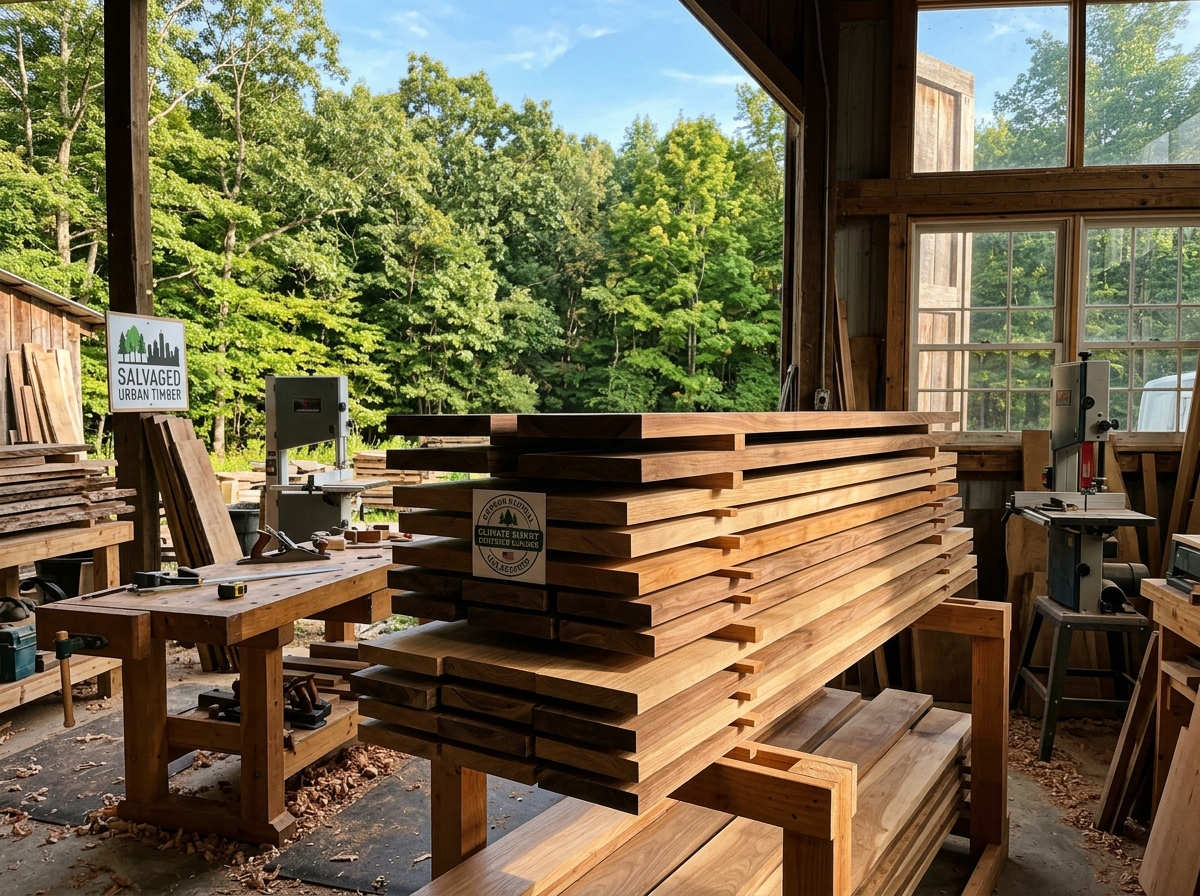
Climate smart hardwood products are wood-based materials sourced and manufactured to actively reduce carbon emissions, support forest health, and minimize waste. Here's a quick look at what makes them different:
- Salvaged or responsibly sourced — from urban tree removals, forest thinning, or fuel-reduction projects
- Carbon-negative or low-carbon — wood sequesters CO₂ rather than releasing it
- Waste-diverting — millions of board feet rescued from landfills each year
- Locally processed — hyper-local supply chains cut transport emissions significantly
- Verified through ESG frameworks and manufacturing marks — so you know what you're getting
Choosing the right wood for your home or design project has always been about quality and beauty. But today, it's also about impact.
Forests are powerful carbon sinks. When trees are managed well — or when wood is salvaged instead of wasted — the result is a material that stores carbon rather than adding to emissions. That's the core idea behind climate smart hardwood: smarter sourcing leads to better outcomes for your project and the planet.
The challenge? Not all "sustainable wood" claims are equal. Knowing what to look for — and what questions to ask — makes all the difference.
I'm Jonathan Geyer from Real American Hardwood Company, and I've spent years sourcing, milling, and distributing premium American hardwoods with a focus on responsible forest stewardship and sustainable practices. In this guide, I'll walk you through exactly how to identify and choose climate smart hardwood products that deliver on their environmental promise.
Defining Climate-Smart Wood and Its Environmental Impact
To understand climate smart hardwood products, we first have to look at how they differ from the status quo. While all Hardwood: Age-Old, Sustainable Choice options are better for the environment than plastic or concrete, climate-smart products go a step further by focusing on the specific climate outcomes of the supply chain.
At its core, a climate-smart product is one that maximizes carbon sequestration and minimizes greenhouse gas (GHG) emissions throughout its lifecycle. This involves a "circular economy" approach—where nothing is wasted, and every byproduct is utilized. For example, naturally fallen hardwood emits 26% less CO₂e than conventional wood because it avoids the high-intensity energy requirements of traditional industrial harvesting. Even more impressively, these products emit seven times less CO₂ than wood-plastic composites.
When we talk about "embodied carbon," we are referring to the emissions generated from extracting, transporting, and manufacturing a material. Climate smart hardwood products act as a net carbon sink. Instead of adding carbon to the atmosphere during production, they keep it locked away in the cellular structure of the wood for decades.
By choosing these materials, we aren't just building a deck or a dining table; we are participating in a system that could potentially cut global emissions by 4% if adopted at scale.
Sourcing and Origins: From Urban Canopies to Forest Thinning
Where does this wood actually come from? Unlike traditional lumber that is harvested from timberlands, climate smart hardwood products often originate from places you might not expect.
One of the primary sources is the "urban canopy." Every year, thousands of trees in our cities are removed. In a conventional system, these trees are often chipped, burned, or sent to a landfill where they rot and release methane. Climate-smart sourcing targets the "4 Ds":
- Disease: Trees that must be removed to prevent the spread of pests.
- Decay: Trees reaching the natural end of their life cycle.
- Disaster: Trees downed by storms, high winds, or floods.
- Development: Trees removed for necessary infrastructure or construction.
Beyond the city limits, we also look to forest thinning and fuel-reduction projects. In many parts of the country, forests have become overgrown due to a century of fire suppression. This overgrowth leads to "climate whiplash," where forests are more susceptible to catastrophic wildfires. By removing small-diameter logs and excess brush, we help the remaining large trees thrive and reduce the risk of high-intensity fires.
Our Hardwood Species Guide highlights how different species, from Red Oak to Poplar, can be utilized in these restoration efforts. Selective logging and reforestation ensure that biodiversity is preserved, creating a habitat that supports wildlife while providing us with beautiful, durable materials.

The Role of Urban Salvage in Climate Smart Hardwood Products
The impact of urban salvage cannot be overstated. Research shows that over 5 million board feet of wood have been diverted from the waste stream through climate-smart initiatives. When we rescue a tree from a landfill, we aren't just saving wood; we are preventing the emissions that would have occurred during decomposition.
This process is inherently local. Why Real Hardwood is so vital to the climate conversation is partly due to the reduction in "wood miles." Hyper-local sourcing—often within a 100-mile radius of the processing facility—reduces the climate impact of transport by an average of 20%. It’s a simple equation: less travel equals fewer emissions.
Environmental Benefits: Carbon Sequestration and Forest Health
The numbers behind climate smart hardwood products are staggering. A single board foot of this wood sequesters an average of 5.23 lbs of CO₂e. To put that in perspective, that is equivalent to the energy required to charge 289 smartphones. When you build a house using these materials, you are essentially creating a massive, beautiful carbon storage vault.
But the benefits extend beyond just carbon. We are also talking about the physical health of our ecosystems. By utilizing wood from forest treatments, we support Sustainability by making forests more resilient. For every 1,000 board feet of climate-smart wood used, approximately four trees are saved from being harvested in traditional timberlands.
Proactive stewardship—including thinning, removals, and prescribed burning—ensures that our forests can handle the stressors of a changing climate. When we remove the "fuel" (small-diameter, low-value wood), we protect the "monarchs" of the forest—the large, old-growth trees that do the heavy lifting for oxygen production and carbon storage.
How to Verify and Select Climate Smart Hardwood Products
As the demand for sustainable materials grows, "greenwashing" becomes a real concern. How can you be sure the flooring or siding you’re buying is actually climate-smart?
First, look for supply chain transparency. A truly climate-smart company should be able to tell you the story of the board—where the tree stood, why it was removed, and how it was processed. Many leaders in this space use advanced inventory management systems to track wood from the moment it is felled to the moment it reaches your job site.
Second, check for recognized manufacturing marks and ESG (Environmental, Social, and Governance) frameworks. These marks indicate that the product was manufactured using processes that minimize GHG emissions and utilize wood waste. While traditional certifications like FSC are excellent, they often don't have specific categories for salvaged urban wood yet, so look for companies that are actively working with certifying bodies to create these new frameworks.
When comparing Hardwood vs. Lookalikes, synthetic "wood" products often rely on petroleum-based resins and high-energy manufacturing. Real hardwood is a natural product that requires significantly less energy to produce and offers much better long-term carbon storage.
Enhancing Durability with Climate Smart Hardwood Products
One of the most exciting advancements in the industry is thermal modification. This is a chemical-free process that uses only heat and steam in a specialized kiln to alter the wood's cellular composition.
Why does this matter for the climate? Because it makes the wood incredibly durable without the need for toxic chemical treatments.
- Dimensional Stability: Thermally modified wood is less likely to cup, warp, or twist.
- Decay Resistance: The process removes the nutrients that fungi and insects feed on, making it naturally resistant to rot.
- Appearance: It gives the wood a deep, rich color that rivals exotic tropical hardwoods.
Over time, if left unfinished, this wood will develop a beautiful silver patina, though it can also be refinished to maintain its original hue. This longevity is a key part of the climate-smart philosophy: the longer a product lasts, the longer that carbon stays out of the atmosphere.
Economic Impact and Applications in Modern Design
Supporting the climate smart hardwood products industry isn't just good for the woods; it's good for people. This sector is a major driver of "green-collar" jobs. From urban arborists and sawyers to specialized kiln operators and designers, this industry creates local employment that cannot be outsourced.
Furthermore, many climate-smart initiatives reinvest a significant portion of their profits back into the community. It is common to see 15% of profits funneled directly into urban forest stewardship, funding the planting of new trees in underserved neighborhoods. This creates a full-circle benefit: we use the wood from trees that must come down to fund the growth of the next generation of the urban canopy.
In terms of design, the applications are nearly limitless. You can See the Value in:
- Custom Interiors: Warm Red Oak flooring or Poplar trim.
- Exterior Siding and Cladding: Using thermally modified hardwoods for a maintenance-free, weather-resistant facade.
- Decking: A sustainable alternative to Ipe or plastic composites.
- Furniture: High-character pieces that tell a story of salvage and renewal.
Frequently Asked Questions about Climate-Smart Wood
How does climate-smart hardwood differ from conventional wood?
While both are renewable, climate-smart hardwood focuses specifically on utilizing waste streams (like urban salvage) and forest restoration byproducts. It prioritizes hyper-local sourcing to reduce transport emissions and often uses chemical-free processes like thermal modification to enhance durability.
Can climate-smart wood be used for structural construction?
Absolutely. Climate smart hardwood products are suitable for all traditional lumber uses, including structural framing, mass timber (like Cross-Laminated Timber or CLT), and exterior siding. They meet the same performance standards as traditionally harvested wood.
How is the carbon footprint of these products verified?
Verification is typically handled through ESG reporting and life-cycle assessments (LCAs). Many producers use proprietary tracking systems to document the carbon sequestered in each board foot, providing builders and architects with hard data to meet their net-zero goals.
Conclusion
At Real American Hardwood, we are proud to support an industry that views our forests and urban canopies as vital partners in the fight against climate change. American hardwoods are a truly renewable resource, with our forests growing at a rate 2.5 times faster than they are harvested. By integrating climate smart hardwood products into our building and design choices, we amplify this natural advantage.
Whether you are an architect looking to decarbonize a new office building or a homeowner wanting a beautiful, story-rich floor, choosing climate-smart wood is a powerful way to vote for a healthier planet. Every board has a story—make sure yours is one of restoration, carbon capture, and domestic craftsmanship.