

Hardwood vs. Softwood: Why Balsa is the Imposter Among Us
The Surprising Truth About Hardwood vs. Softwood Trees
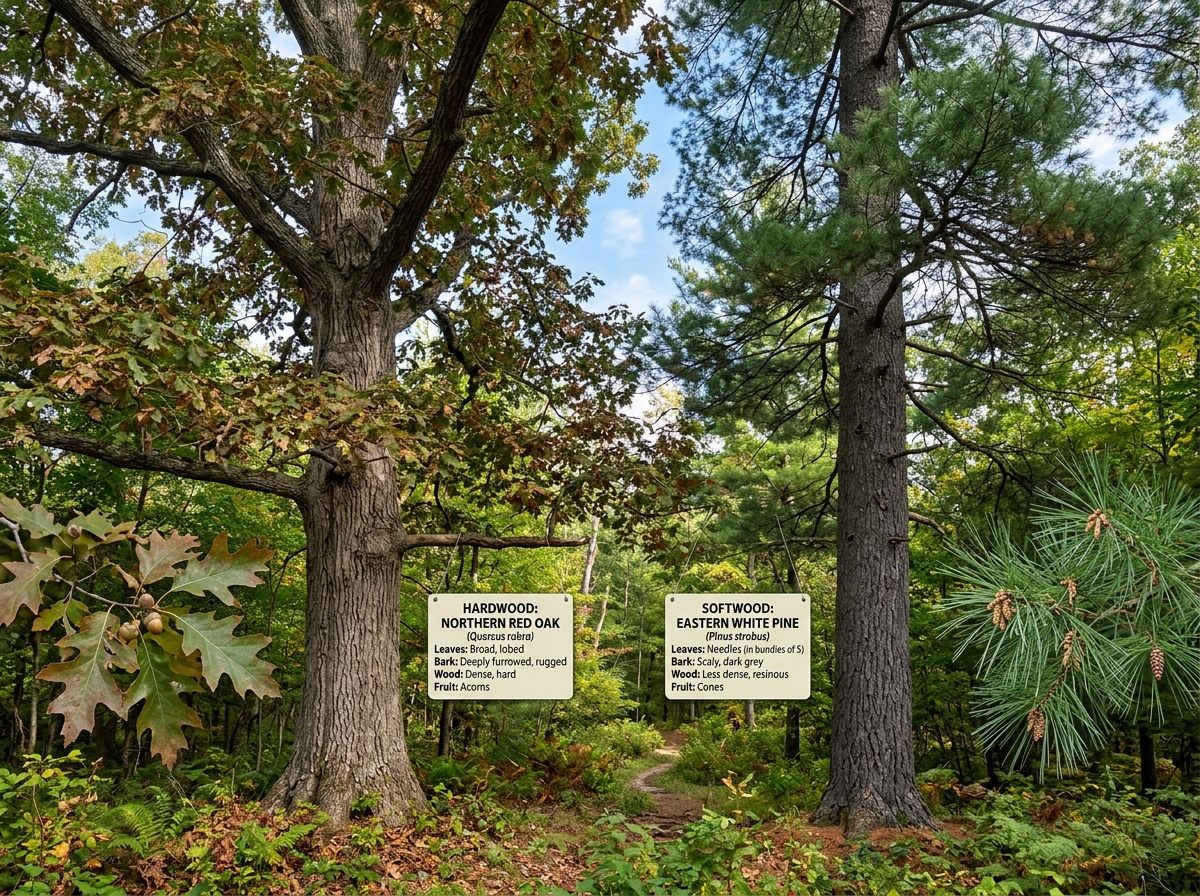
Hardwood vs. softwood trees are classified by biology, not by how hard or soft the wood actually feels.
Here's the part that surprises most people: balsa wood is technically a hardwood. It comes from a deciduous tree, so botanists call it a hardwood. But with a Janka hardness rating below 100 lbf, it's softer than almost every softwood on the market. Meanwhile, yew — a conifer, and therefore a softwood — is denser than many species we call hardwoods.
The names are genuinely misleading. And that confusion leads to real mistakes when choosing materials for floors, furniture, or outdoor builds.
I'm Jonathan Geyer from Real American Hardwood, and I've spent years sourcing, milling, and distributing premium American hardwoods — giving me hands-on experience with exactly how hardwood vs. softwood trees perform across hundreds of real-world applications. Let's clear up the confusion for good.

The Botanical Divide: Angiosperms vs. Gymnosperms
When we talk about hardwood vs softwood trees, we aren't actually talking about the density of the lumber in your hand. We are talking about how the tree reproduces. This is a distinction that dates back millions of years.
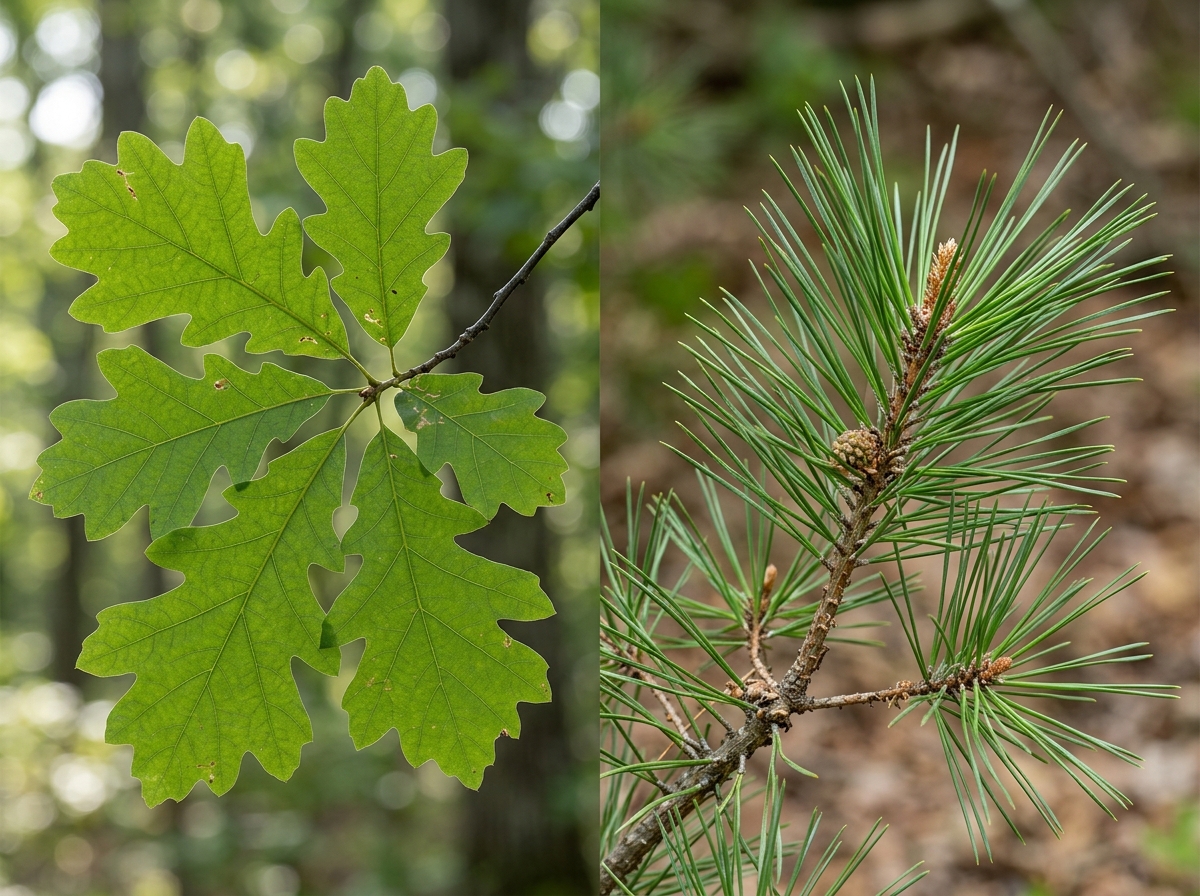
Hardwood trees belong to a group called angiosperm. These are flowering plants that produce seeds enclosed within a fruit, nut, or pod. Think of an apple tree, an oak tree dropping acorns, or a walnut tree. There are an estimated 225,000 to 425,000 existing species of angiosperms on Earth. They typically have broad leaves that change color and drop in the autumn—a process we call being "deciduous."
On the flip side, softwood trees are gymnosperms. This botanical classification comprises approximately 1,000 living species. Unlike their flowering cousins, gymnosperms produce "naked" seeds. They don't have the luxury of a protective fruit; instead, their seeds are usually tucked away in the scales of a cone. Most gymnosperms are evergreens with needle-like or scale-like leaves that stay green all year round.
Microscopic Differences in Hardwood vs Softwood Trees
If we were to take a peek under a microscope, we would see that the internal plumbing of these trees is completely different. This "plumbing" is what gives wood its unique grain and character.
Hardwoods are more complex. They possess specialized structures called vessel elements. These vessels look like long tubes that transport water throughout the tree. When the wood is cut, these vessels appear as tiny holes or "pores." This is why you might hear woodworkers talk about "open-grained" woods like Oak or "closed-grained" woods like Maple. These pores create the intricate, swirling grain patterns that we love in high-end furniture.
Softwoods are much simpler. They lack these vessel elements. Instead, they rely on tracheids—long, narrow cells that serve a dual purpose: they transport water and provide structural support. Because they lack pores, softwoods generally have a much more uniform, straighter appearance.
Even the chemistry is different! Hardwoods contain higher levels of xylans, which are a type of complex sugar found in the cell walls. Softwoods, however, are richer in glucomannans. These microscopic differences are the reason why an Oak board feels and reacts so differently to a saw blade than a Pine board does.
Debunking the Name: Is Hardwood Always Harder?
One of the biggest myths we encounter is the idea that "hardwood" is always more durable than "softwood." While it’s a good rule of thumb, it isn't a law of nature.
To measure how hard a wood actually is, the industry uses the Janka hardness test. As described in the USDA Forest Products Laboratory's Wood Handbook, this test measures the force required to embed a 0.444-inch steel ball halfway into a piece of wood.
SpeciesClassificationJanka Rating (lbf/Newtons)White OakHardwood1,360 lbfHard MapleHardwood1,450 lbfYewSoftwood1,600 lbfLoblolly PineSoftwood690 lbfYellow PoplarHardwood540 lbfBalsaHardwood100 lbf
As you can see from the table above, the lines get blurry. Yew is a softwood, but it is actually harder than many common hardwoods like White Oak or Ash. Conversely, Yellow Poplar is a botanical hardwood, but it is softer than many species of Pine. This is why we always tell our customers: don't just look at the category—look at the specific species' density and strength-to-weight ratio for your project.
The Balsa Paradox in Hardwood vs Softwood Trees
This brings us to the ultimate "imposter": Balsa wood. Balsa is the go-to material for model airplanes because it is incredibly light and easy to cut with a simple hobby knife. If you felt a piece of Balsa, you would bet your house that it’s a softwood.
However, because the Balsa tree is a flowering angiosperm with broad leaves, it is scientifically a hardwood. According to the Wood Database, Balsa often tops the list of the softest available woods. It has a density of only about 9.4 lbs/ft³, compared to White Oak which sits around 47 lbs/ft³.
Balsa is the perfect example of why the botanical definition matters. It has the vessel elements and pore structure of a hardwood, but its cell walls are so thin and filled with air that it lacks any real structural integrity for heavy construction. It’s a hardwood by birth, but a "softie" by nature.
Practical Comparison of Hardwood vs Softwood Trees
When we move from the lab to the workshop, the differences between hardwood vs softwood trees become very practical. It usually comes down to growth rates, aesthetics, and how the wood behaves under a chisel or sander.
Softwoods grow like weeds. A typical Pine or Fir tree can reach maturity and be ready for harvest in about 25 to 40 years. Because they grow so fast, their wood is less dense, and they are readily available in massive quantities. In fact, the United States plants approximately 2.6 billion softwood seedlings every single year to keep up with demand.
Hardwoods are the "slow and steady" winners of the forest. Some species can take up to 150 years to reach harvestable size. This slow growth is what creates that incredible density and those beautiful, tight grain patterns. You can see the variety of these patterns in our Hardwood Species Guide. While softwoods tend to be pale (yellows and light reds), hardwoods offer a stunning palette ranging from the creamy white of Sap Maple to the deep, chocolatey browns of Black Walnut.
Workability is another major factor. Softwoods are generally easy to work with hand tools, making them great for DIY projects or framing a house. However, they can be "pitchy" (sticky with resin) and prone to denting. Hardwoods require sharper, often carbide-tipped tools because of their density, but they finish beautifully. They take stains more evenly and can be polished to a high luster that softwoods simply can't match.
Cost and Availability Factors
If you’ve ever walked through a lumber yard, you know there is a significant price gap between a 2x4 stud and a Walnut board. This isn't just because one is "prettier." It’s a matter of economics and time.
According to USDA statistics, softwood accounted for 80% of U.S. lumber production in 2017. Because softwoods grow so quickly and are easier to process, they are the backbone of the construction industry. Pine lumber alone accounts for about 60% of structural lumber used in residential homes.
Hardwoods represent a smaller, more specialized market. Because they take three to four times longer to grow, the supply is naturally more limited. This makes the "stumpage" value higher for the landowner and the final price higher for the consumer. While the softwood market is tied closely to the volume of new home construction, the hardwood market is driven by the demand for high-end, value-added products like luxury furniture and premium flooring.
Choosing the Right Wood for Your Project
Choosing between hardwood vs softwood trees depends entirely on what you are building. We like to say: use softwood for the bones of the house, and hardwood for the soul.
For high-traffic areas, hardwood is the undisputed king. Red Oak, for example, represents over 40% of hardwood floor installations in American homes as of 2024. Its Janka hardness makes it resistant to the scratches and scuffs of daily life—especially if you have pets or kids. If you’re considering a "lookalike" material, we suggest checking out our guide on Hardwood vs Lookalikes to see why real wood stands the test of time.
Softwoods like Cedar and Redwood are fantastic for outdoor use because they contain natural oils that resist rot and insects. However, they are soft. If you build a deck out of Pine, it might last 15-20 years if pressure-treated, but it will show every heel mark and dropped BBQ tong.
For furniture that you want to pass down to your grandchildren, you want hardwood. A handcrafted Walnut or Cherry table isn't just a piece of furniture; it’s an investment. Hardwoods hold fasteners better, resist warping over decades, and develop a beautiful patina as they age.
Best Applications for Hardwood
Because of its superior strength and beauty, hardwood is the gold standard for several specific applications:
- Cabinetry: Hardwood faces and frames provide the durability needed for doors that are opened and closed thousands of times a year.
- Musical Instruments: The density and "acoustic" properties of hardwoods like Maple and Walnut make them essential for guitar necks and piano rims.
- High-Class Joinery: If you are doing intricate mouldings or millwork, the tight grain of hardwoods ensures that the wood won't splinter or "fuzz" when cut.
- Tool Handles: Species like Hickory and Ash are used for hammers and axes because they can absorb shock without breaking.
Hardwood is truly an Hardwood: Age-Old Sustainable Choice for those who value longevity over a quick fix.
Sustainability and Environmental Impact
At Real American Hardwood, we are passionate about the fact that wood is the most renewable building material on the planet. But there are differences in how hardwood and softwood forests are managed.
Hardwood forests in the United States cover approximately 158 million acres—about 33% of the nation’s total forest area. These forests are largely managed through selective harvesting, meaning we don't clear-cut entire mountainsides. Instead, we remove mature trees, which allows sunlight to reach the forest floor and stimulates the growth of younger trees.
Our USP is simple: American hardwood is a truly renewable resource. Our forests are currently growing 2.5 times faster than they are being harvested. This is a massive win for the environment because growing trees are "carbon sinks"—they capture CO2 from the atmosphere and store it in their wood for centuries.
Softwood production is also incredibly sustainable, but it often relies on plantation-style farming. In the US, we plant about 2.6 billion softwood seedlings annually to ensure a steady supply of construction lumber. Both types of wood play a critical role in a green economy, but hardwoods offer a unique long-term carbon storage solution because the products made from them (like flooring and furniture) stay in use for much longer than a typical softwood shipping pallet or paper product.
For more on how we protect our forests, visit our page on Sustainability.
Frequently Asked Questions about Wood Classification
Which wood is better for high-traffic flooring?
Hardwood is almost always the better choice for high-traffic areas. Specifically, species like Red Oak, White Oak, and Hard Maple have high Janka ratings that allow them to resist denting and scratching. Softwoods like Pine are sometimes used for "rustic" flooring, but they will develop a "distressed" look very quickly as the wood is compressed by footsteps and furniture.
Why is softwood used more in construction?
Softwood accounts for about 80% of all lumber production because it is affordable, lightweight, and easy to nail. When you are framing a house, you don't need the decorative grain of Walnut; you need straight, long boards that can be produced quickly and cheaply. Softwoods like Spruce, Pine, and Fir (collectively known as SPF) are the industry standard for structural framing.
How can I visually tell the difference between types?
Look at the pores. If you see tiny holes (vessels) in the end grain, it’s a hardwood. Hardwoods also tend to have more complex, "busy" grain patterns. Softwoods usually have a very clean, straight grain with a more uniform color. You can also look at the leaves of the tree: broad leaves mean hardwood, while needles mean softwood.
Conclusion
Understanding the difference between hardwood vs softwood trees is about more than just botanical trivia. It’s about making sure your next project—whether it’s a DIY bookshelf or a full home renovation—is built to last.
While the names can be misleading (as our friend the Balsa tree proves), the underlying biology tells a story of strength, beauty, and sustainability. By choosing Real American Hardwood, you are supporting a system where forests grow 2.5 times faster than they are harvested, ensuring that we continue to capture carbon and provide beautiful materials for generations to come.
Ready to find the perfect species for your home? Explore our Hardwood Species Guide and discover the incredible diversity of the American forest.