

Kiln Dried vs. Air Dried Lumber: What Hardwood Buyers Need to Know
Every board of American hardwood starts out wet, and how it gives up that water shapes how well it holds its joints, profiles, and finish in furniture, cabinets, doors, and millwork. This guide explains how wood holds moisture, how air drying and kiln drying work, and how to choose and specify the right material for the job.
Why Does Hardwood Need to Be Dried at All?
Hardwood is dried so that it does its shrinking before it becomes a finished product. The Wood Database explains that a freshly felled tree is in the green state and “contains a very large amount of moisture,” held in two forms: free water in the pores and bound water in the cell walls.
Free water leaves first. The point where the cell cavities are empty but the cell walls are still saturated is called the fiber saturation point, which the Wood Database puts at roughly 30% moisture content for most species. Below that point, the wood begins giving up bound water, and that is when it starts to shrink.
Eventually wood settles at a moisture level set by the surrounding air. The Wood Handbook defines this equilibrium moisture content (EMC) as “the moisture content at which wood neither gains nor loses moisture when surrounded by air at a given relative humidity and temperature.” Indoors, the Wood Database notes that most buildings are kept between 30% and 60% relative humidity, which corresponds to about 6% to 11% EMC.
That range is the target. Lumber dried to roughly the moisture content it will see in service does its shrinking at the mill, not in a client’s dining room. The Wood Handbook states the principle directly: install wood at the moisture content it will experience in service to minimize dimensional change after installation.
What Is the Difference Between Kiln Dried and Air Dried Lumber?
The difference is the drying environment. The Wood Handbook defines air-dried lumber as “dried by exposure to air in a yard or shed, without artificial heat,” and kiln-dried lumber as “dried in a kiln with the use of artificial heat.” A kiln is “a chamber having controlled air-flow, temperature, and relative humidity for drying lumber.”
That control shapes the result in several ways. On moisture content, thoroughly air-dried lumber reaches about 12% to 15% in much of the United States, according to the Wood Handbook, while the Wood Database notes that a kiln can dry wood to whatever level an application calls for, such as 6%. On speed, air drying is slow and depends on the season, while a kiln works on a planned schedule and moves significantly faster. On uniformity, air drying varies with weather, location, and position in the stack, while a kiln dries the load more evenly. Kilns also bring a secondary benefit: the Wood Database notes that high kiln temperatures kill powderpost beetles in all stages of their development.
The two methods each have a natural role. Air drying suits exterior and unheated uses and works well as a first stage before the kiln. Kiln drying is the standard for interior furniture, cabinetry, doors, and millwork. The Wood Handbook notes that moisture content requirements are “more exacting for finished lumber and wood products used inside heated and air-conditioned buildings than those for lumber used outdoors or in unheated buildings.”
How Does Air Drying Work, and How Long Does It Take?
Air drying works by stacking lumber outdoors or under a roof with spacers between layers so air can move through the pile. The Wood Database describes these spacers, called stickers, as small pieces of wood “usually about 3/4” x 1 1/2”” that open space between boards, increasing ventilation and promoting more uniform drying.
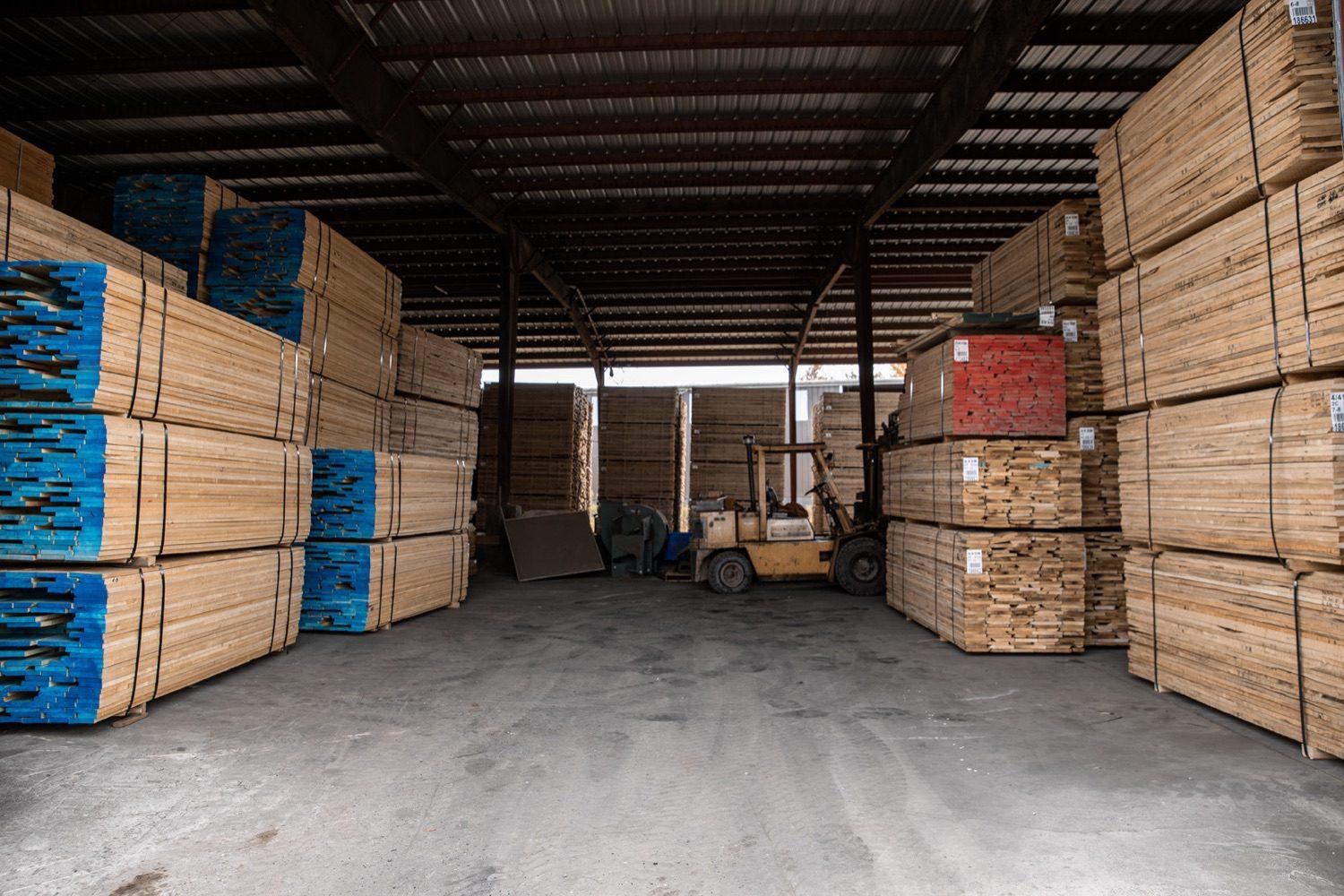
Air drying takes patience, and its pace depends on species and conditions. According to the Wood Handbook, the time needed to air dry lumber to 20% to 25% moisture content ranges from 15 to 30 days for some low-density species, such as red alder and soft maple, to 200 to 300 days for slow-drying species, such as oak and birch, in northern locations. The traditional woodworker’s rule of thumb, as the Wood Database notes, is to allow about one year of air drying per inch of thickness.
Weather sets the terms. The Wood Handbook notes that drying “is very slow during the cold winter months,” and that very hot, dry winds or warm, humid, still periods can both work against an even result. Holding a large inventory of high-value lumber for months is also a real cost for a yard. Good air drying practice pays attention to the details: even stickering, good airflow, and protection of board ends, since the Wood Database notes that moisture escapes “about 10 to 12 times faster on the ends than through other surfaces.”
How Does Kiln Drying Work?
Kiln drying works by placing stickered lumber in a closed chamber where operators control temperature, humidity, and airflow through a planned schedule. The Wood Handbook explains that higher temperatures and faster air circulation “significantly increase the drying rate,” and that a kiln can bring lumber to the lower moisture levels interior products require.
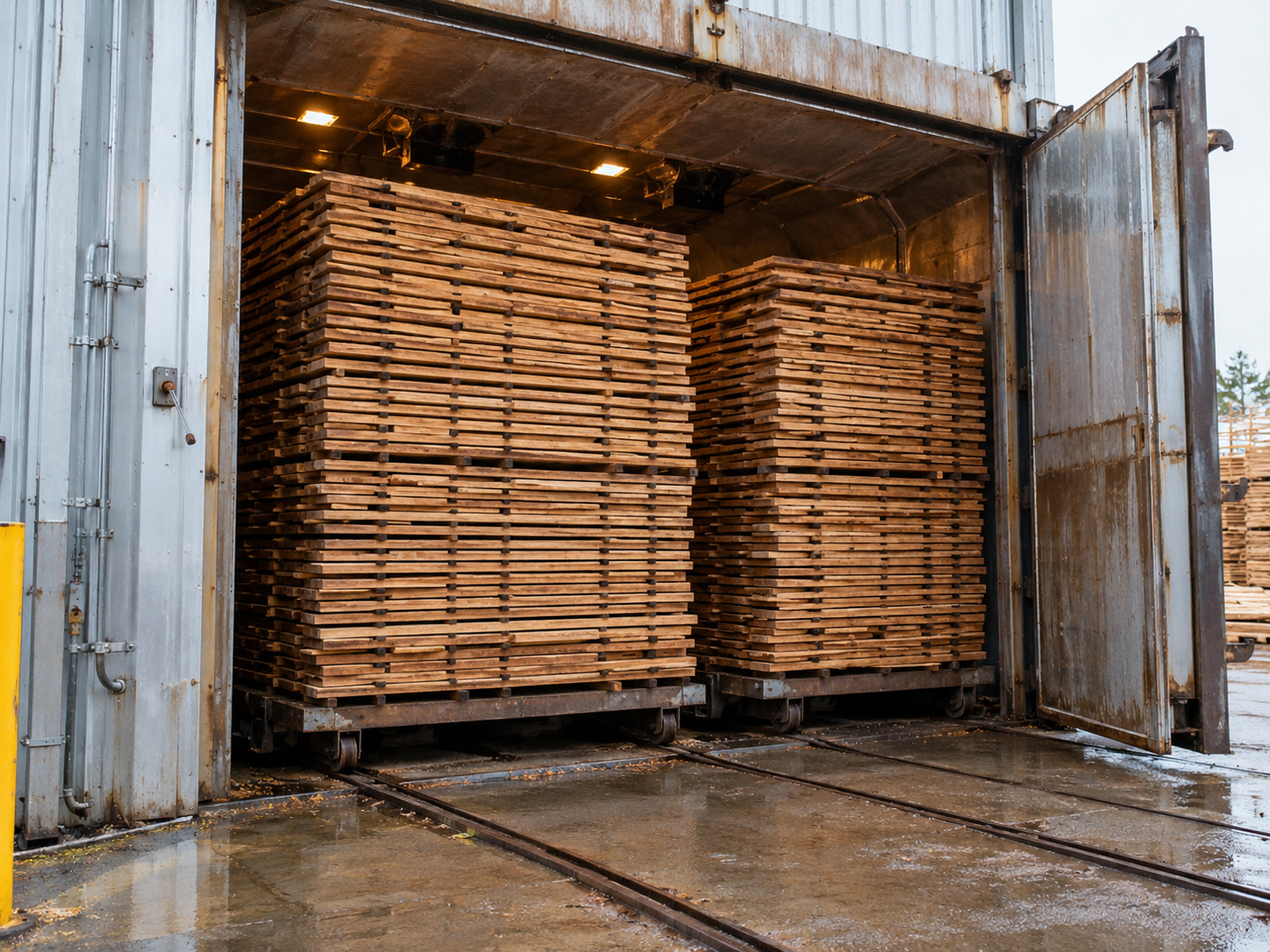
Control is the real advantage. The Wood Database observes that a kiln “is able to dry wood much more evenly, and it’s this uniformity in drying that allows it to also dry the wood quickly.” Hardwood schedules are measured and gentle compared with many softwood schedules. As one example, the Wood Handbook lists kiln temperatures for black walnut ranging from 120°F to 180°F (49°C to 82°C), while conventional softwood drying runs below 212°F and high-temperature softwood drying goes above 230°F.
In practice, the two methods often work together. The Wood Handbook notes that “air drying lumber down to 20% to 25% moisture content prior to kiln-drying is common.” Pre-drying in the yard removes much of the free water at low cost, and the kiln finishes the job with the precision interior work demands.
Skilled drying also opens the door to species and sources that reward extra care. In “From Curbside to Centerpiece,” featured on realamericanhardwood.pro, Angel City Lumber founder Jeff Perry’s Los Angeles mill works California sycamore from trees felled within Los Angeles County. The article notes that the species “demands meticulous stickering and stacking in a dehumidification kiln,” and that when it is done right, “it gives some of the most dramatically figured grain and richest color ACL mills.”
What Does Well-Dried Lumber Deliver?
Well-dried lumber delivers boards that machine cleanly, glue reliably, and stay true once built. The Wood Handbook explains that drying stresses, caused by the outer shell and inner core of a board shrinking at different rates, are the main source of drying-related quality issues, and a well-run kiln schedule is designed to keep those stresses in check.
For trade buyers, a few Wood Handbook terms are worth knowing when talking with a supplier:
- Checks. “A lengthwise separation of the wood that usually extends across the rings of annual growth.” Careful drying keeps faces and ends clean.
- Case-hardening. A condition of stress in dry lumber with “compressive stress in the outer layers and tensile stress in the center.” Properly conditioned lumber stays stable when resawn or ripped.
- Collapse and honeycomb. Internal drying issues that a controlled schedule is designed to prevent.
The simplest quality step is to ask. A reliable supplier will tell you how the lumber was dried and to what moisture content, and many shops confirm incoming stock with a moisture meter before it goes into production.
Which Should You Buy: Kiln Dried or Air Dried Hardwood?
For interior furniture, cabinetry, doors, paneling, and millwork, specify kiln dried hardwood. The Wood Handbook recommends interior woodwork average about 8% moisture content in most areas of the United States, with individual pieces between 6% and 10%. In the dry Southwest the average target is 6% (4% to 9% for individual pieces), and in damp, warm coastal areas it is 11% (8% to 13%). Air drying alone generally cannot reach those levels in most of the country.
Air dried lumber has its own place. It suits exterior projects and unheated structures, where the Wood Handbook notes moisture requirements are less exacting.
Whatever you buy, give it time to acclimate. Bring lumber into the shop or jobsite where it will be worked and let it settle toward the local EMC before cutting. That step costs little and keeps joints and panels tight after the work is built.
Grade and drying are separate questions. National Hardwood Lumber Association (NHLA) rules set grade by clear-cutting yield: FAS (Firsts and Seconds) at least 83.3% clear yield and No. 1 Common at least 66.7%. A strong specification names the species, the grade, and the target moisture content.
How does your shop make sure incoming lumber is ready? Whether you meter every board or rely on a trusted supplier, tell us how you make sure the wood is ready before it hits the saw.
Frequently Asked Questions
Is kiln dried lumber better than air dried? For interior work, generally yes. According to the Wood Handbook, thoroughly air-dried lumber reaches only about 12% to 15% moisture content in much of the United States, while interior woodwork should average about 8% in most areas. Kiln drying reaches those lower targets with more control.
How long does it take to air dry hardwood? It depends on species, thickness, and climate. The Wood Handbook reports that air drying to 20% to 25% moisture content can take 15 to 30 days for low-density species like red alder and soft maple, and 200 to 300 days for slow-drying species like oak and birch in northern locations. A traditional rule of thumb is one year per inch of thickness.
What moisture content should hardwood be for furniture? The Wood Handbook recommends an average of 8% for interior woodwork in most of the U.S., 6% in the dry Southwest, and 11% in damp, warm coastal regions. The goal is to match the moisture content the wood will reach in service.
Does kiln drying kill insects in wood? The Wood Database notes that kiln drying at high temperatures kills powderpost beetles in all stages of their development. Air drying does not offer that benefit on its own.