

Log Cabin Logs: What's the Best Type of Wood?
The Best Log Cabin Logs Start With Choosing the Right Wood

Log cabin logs are the heart of any log home — and the wood species you choose affects everything from durability and insulation to how the finished cabin looks and feels.
Here's a quick comparison of the most common wood species used for log cabin logs:
Each species has real trade-offs. Cedar resists rot naturally. Pine is easy to cut and stain. Oak is tough but heavy. The "best" choice depends on your climate, budget, and the look you want.
Beyond wood species, your logs' profile, drying method, and corner joinery all shape how your cabin performs over decades. This guide breaks all of it down — simply and clearly.
I'm Jonathan Geyer from Real American Hardwood Company, and my background in sourcing and milling premium American hardwoods — including species commonly used for log cabin logs — gives me a practical, on-the-ground perspective on what actually works in the real world. Let's dig into what separates a great log cabin build from one that causes headaches down the road.
Popular Wood Species for Log Cabin Logs
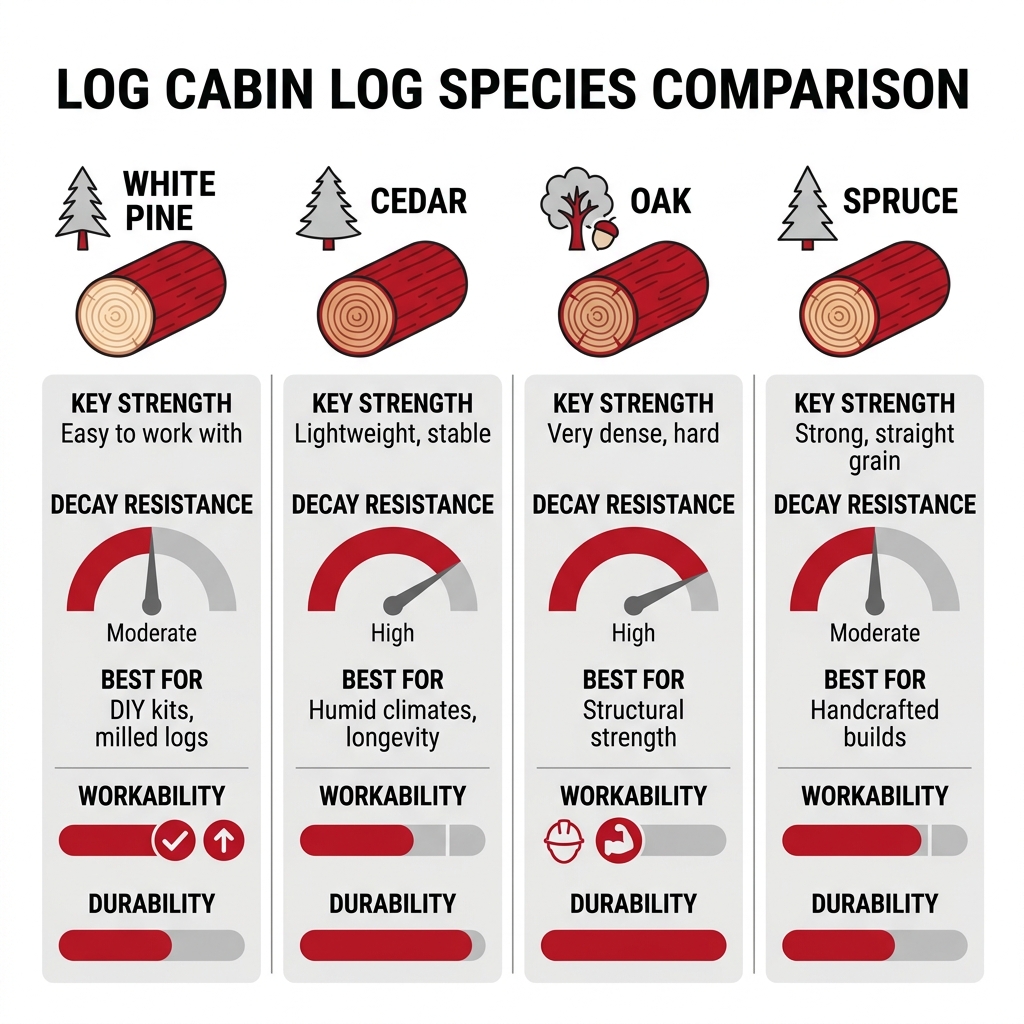
When we talk about log cabin logs, the species of wood is the foundation of the entire project. In the United States, we are blessed with a diverse range of timber that offers unique characteristics for construction. Choosing the right one isn't just about the price tag; it's about how the wood interacts with your local environment.
White Pine
Eastern White Pine is perhaps the most popular choice for milled log cabin logs. It is a durable wood species that is famously easy to cut, stain, and treat against decay. One of its biggest draws is its beautiful, tight grain and uniform pattern, which provides that classic "cabin" look. Because it is relatively lightweight and has low resin content, it takes preservatives well, ensuring a long life if maintained properly.
Western Red Cedar
If you are building in a damp or humid climate, Western Red Cedar is often the gold standard. It possesses high natural resistance to rot, decay, and insect infestation. Cedar is also highly stable, meaning it is less likely to twist or warp as it dries. While it typically carries a higher price point, its longevity and natural oils make it a favorite for those looking for a "legacy" home.
Oak
For those who want a cabin that feels like a fortress, Oak is the answer. As a hardwood, it is incredibly dense and heavy, offering superior structural strength and excellent decay resistance. While it is more challenging to work with than softwoods — requiring specialized tools and more labor — the result is a home with massive character and unmatched durability. Oak logs often feature stunning grain patterns that only get better with age.
Spruce
Spruce is often favored for handcrafted builds because it grows tall and straight, providing long, consistent lengths of timber. It has a high strength-to-weight ratio and a pale, clean aesthetic. However, Spruce has lower natural decay resistance than Cedar or Oak, so it requires diligent staining and sealing to protect it from the elements.
Understanding Log Profiles and Aesthetic Finishes
The "profile" of a log refers to the shape it is cut into. This choice dictates how the logs fit together and how the finished wall looks — both inside and out.
Common Log Profiles
- D-Log: This is the most common profile in the industry. It is milled flat on the inside (looking like a "D") and remains round on the outside. This gives you the classic log look on the exterior while providing flat interior walls that make it easier to hang pictures or install cabinets.
- Round-on-Round: These logs are round on both the exterior and interior. It provides a very traditional, rustic feel, often associated with deep-woods retreats.
- Square/Rectangular Timber: Often used in Appalachian-style cabins, these logs are milled flat on all four sides. They are frequently used with chinking (the white sealant between rows) for a historic aesthetic.
- Swedish Cope: This profile features a circular log with a crescent-shaped groove cut out of the bottom. This allows the logs to "nest" tightly on top of each other, creating a natural seal and a beautiful stacked appearance.
Aesthetic Finishes and Textures
Beyond the shape, the texture of your log cabin logs adds another layer of character.
- Milled Finish: These logs are run through a planer, resulting in a smooth, uniform surface. It's perfect for a contemporary or "neat" log home look.
- Hand-Peeled: Using a drawknife, builders strip the bark by hand. This leaves the natural "knobs" and imperfections of the tree, giving the cabin a rugged, handcrafted soul.
- Rough Sawn: This finish leaves the marks from the sawmill blade on the wood, offering a rustic, circular-sawn or band-sawn texture that reflects a more industrial-heritage style.
- Chiseled or Adzed: This technique mimics the look of early pioneers who shaped logs with hand tools, creating a scalloped, textured surface that plays beautifully with interior lighting.
Structural Integrity: Drying Methods and Corner Joinery
A log cabin is a living structure. Wood naturally holds water, and how that water is removed determines whether your walls stay straight or start to "dance" (warp and twist) over time.
Air-Dried vs. Kiln-Dried
Most experts agree that logs should be dried to an optimal 12-14% moisture content before construction.
- Kiln-Dried: Logs are placed in a large oven (kiln) where heat and airflow precisely reduce moisture. This process also kills any fungi or insects living in the wood. Kiln-dried timber is generally more stable and complies better with modern insulation codes.
- Air-Dried: Logs are stacked and left to dry naturally over months or years. Some builders prefer air-drying as it allows the wood to reach an equilibrium with the local environment more slowly. However, air-dried homes may experience slightly more "settling" as the logs reach their final moisture level.
Corner Joinery Techniques
The corners are where the magic happens in log construction. They aren't just for looks; they provide the structural "lock" for the entire building.
- Saddle Notch: A classic look where a U-shaped notch is cut into the bottom of the overlapping log. It's incredibly strong and iconic.
- Dovetail: Often used with square logs, this joinery uses interlocking fan-shaped cuts. It is self-draining and actually gets tighter as the cabin's weight settles on it.
- Butt and Pass: A simpler method where logs alternate, with one "butting" against the side of the other. While faster to build, it relies heavily on structural fasteners like lag bolts rather than the wood's own geometry.
To ensure long-term stability, we recommend working with professionals who understand the nuances of the land. You can learn more about the people behind the timber through Logging, Forestry and Forest Landowner (FLO).
Comparing Full Logs with Half Log Siding
Not every "log home" is built the same way. Depending on your budget and insulation needs, you might choose between solid timber and a hybrid approach.
Full Logs
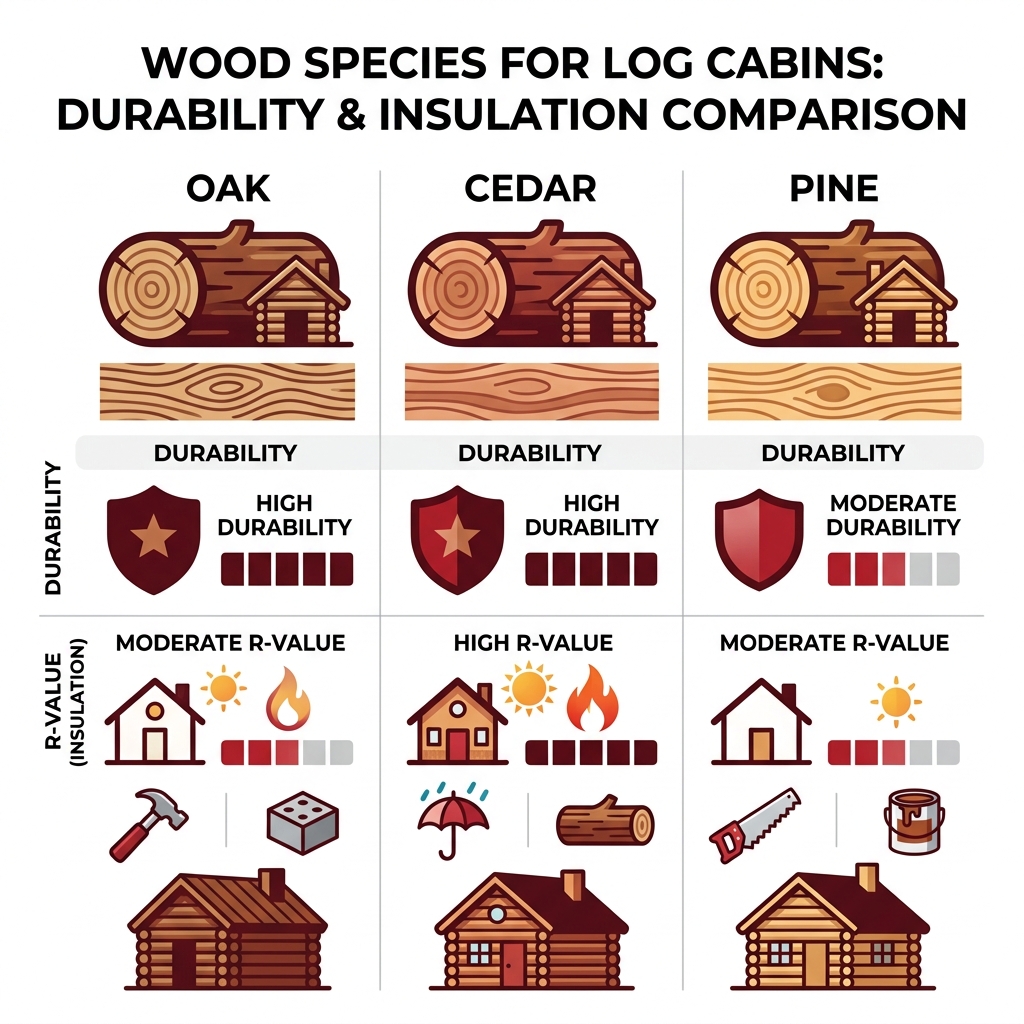
Building with full log cabin logs provides the "real deal." These structures rely on the thermal mass of the wood. While wood's R-value (a measure of thermal resistance) isn't as high as fiberglass insulation, the thickness of the log allows it to store heat during the day and release it at night. This creates a very comfortable, stable interior temperature.
Half Log Siding and SIPs
For those who want the look of a log cabin but the efficiency of modern construction, half log siding is a popular alternative.
- Half Log Siding: This is installed over a standard stick-framed wall. It gives you the exact look of a full log home externally but allows you to use high-efficiency insulation (like spray foam or batts) inside the wall cavity.
- Structural Insulated Panels (SIPs): Some modern "rapid" kits use SIPs with log-look siding. These offer incredible insulation values, often ranging from R-13 to R-15, and can be assembled much faster than traditional logs.
Sustainability and the Environmental Impact of Timber
At Real American Hardwood, we believe that choosing wood is one of the most responsible decisions a builder can make. Unlike concrete or steel, wood is a truly renewable resource.
Our American hardwood forests are a success story of sustainability. Currently, these forests are growing 2.5 times faster than they are being harvested. This growth is vital for the planet because trees are nature's best carbon-capture technology. As trees grow, they pull carbon dioxide from the atmosphere and store it in their fibers. When we use those trees for log cabin logs, that carbon remains "locked up" for the life of the home, rather than being released back into the air.
By choosing responsibly harvested timber, you are supporting Logging, Forestry & Forest Landowners who manage these lands to ensure they remain healthy and productive for generations to come. Building a log home isn't just about rustic charm; it's about building a future that respects the natural world.
Frequently Asked Questions about Log Cabin Logs
What is the best moisture content for log cabin logs?
The "sweet spot" for most construction is between 12-14% moisture content. If logs are too wet (green), they will shrink significantly as they dry in place, leading to gaps, air leaks, and twisted door frames. Kiln-drying is the most reliable way to achieve this stability before the logs ever reach your job site.
How do different log cabin logs affect insulation?
Insulation is a mix of R-value and thermal mass. A solid 8-inch log wall typically offers an insulation value of approximately R-12. While this might seem lower than a framed wall on paper, the density of the wood prevents rapid temperature swings. Dense hardwoods like Oak have more thermal mass, while softwoods like Cedar have slightly higher R-values due to the air pockets in the wood fibers.
Are pre-cut log kits better than handcrafted logs?
It depends on your priorities!
- Pre-cut kits: These logs are precision-milled and often pre-drilled for lag bolts (usually spaced about 20 inches on center). This can cut the log raising timeframe by half, making it ideal for DIYers or those on a tight schedule.
- Handcrafted logs: These offer a unique, one-of-a-kind artistic value. Every log is custom-fit to the one below it. While more expensive and time-consuming, the character of a handcrafted home is incomparable.
Conclusion
Choosing your log cabin logs is a journey that balances aesthetics, science, and environmental responsibility. Whether you opt for the easy workability of White Pine, the rot-resistance of Western Red Cedar, or the massive strength of American Oak, you are choosing a material that is natural, beautiful, and sustainable.
At Real American Hardwood, we invite you to embrace the warmth and carbon-capturing power of wood. By building with hardwood, you aren't just making a house; you're making a statement about the world you want to live in. Ready to start your project? Build Your World with the strength and beauty of American timber.