

Quartersawn vs. Rift Sawn vs. Plain Sawn Lumber: How to Specify the Cut
Every board carries a record of how it was cut from the log, and that orientation decides how it looks, how it behaves across its width, and how much lumber the log yields. This guide covers the definitions, the movement data, the visual character of each cut, and how to write the cut into a spec.
What Is the Difference Between Quartersawn, Rift Sawn, and Plain Sawn Lumber?
The difference is the angle between the growth rings and the wide face of the board. The USDA Forest Products Laboratory’s Wood Handbook gives the formal definitions:
- Edge-grained (quartersawn) lumber has wide surfaces that “extend approximately at right angles to the annual growth rings.” The Handbook considers lumber edge grained “when the rings form an angle of 45° to 90° with the wide surface.”
- Flat-grained (plain sawn or flatsawn) lumber is “sawed parallel to the pith and approximately tangent to the growth rings.” The Handbook considers lumber flat grained “when the annual growth rings make an angle of less than 45° with the surface.”
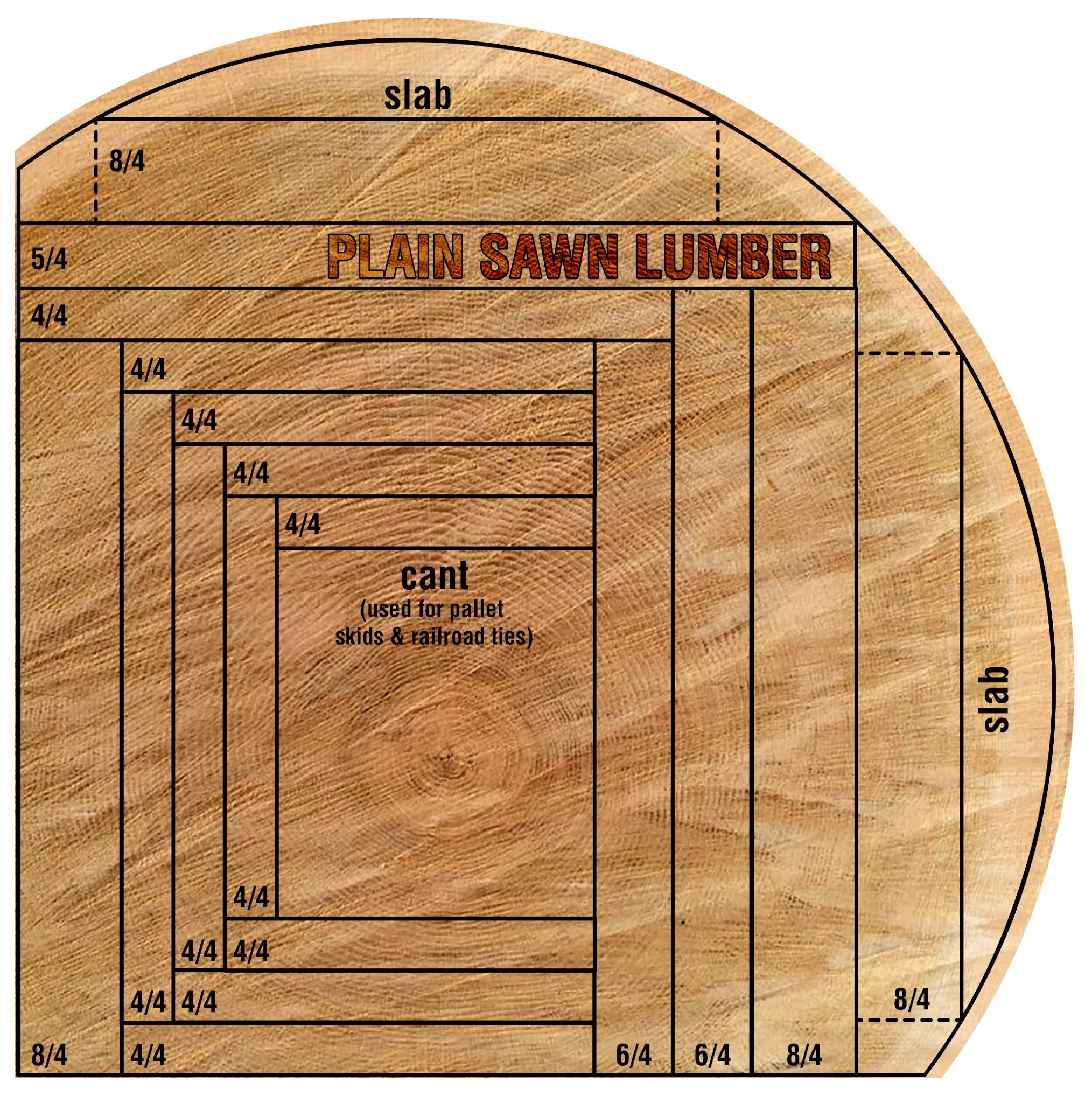
The American Hardwood Information Center (hardwoodinfo.com) adds the trade definition of the third cut. Rift sawn lumber has “the growth rings at 30 to 60 degree angles to the board surface,” which “produces a vertical or straight grain appearance that is easily confused with quarter-sawn.” The Center describes quartersawn boards as having growth rings “perpendicular to the board’s broad face, producing a vertical and uniform grain pattern,” and plain sawn boards as having rings “parallel to the board’s surface, creating the distinctive flame-shaped, arch or cathedral grain pattern.”
The Handbook splits at 45°, while the trade definition of rift spans 30° to 60°, which is the best argument for writing the expected ring angle range into the specification.
How Do the Three Cuts Compare on Yield and Cost?
Plain sawn lumber is the most economical cut, and quartersawn and rift are premium products. The geometry of the log explains why.
According to the American Hardwood Information Center, “at least 95 percent of all hardwood lumber commercially produced in the U.S. is flat or plain sawn.” The Center notes that plain sawing “yields the most lumber and produces the widest possible boards with the least log waste,” and that “it is the most cost effective.” Plain sawn is the workhorse of American hardwood.
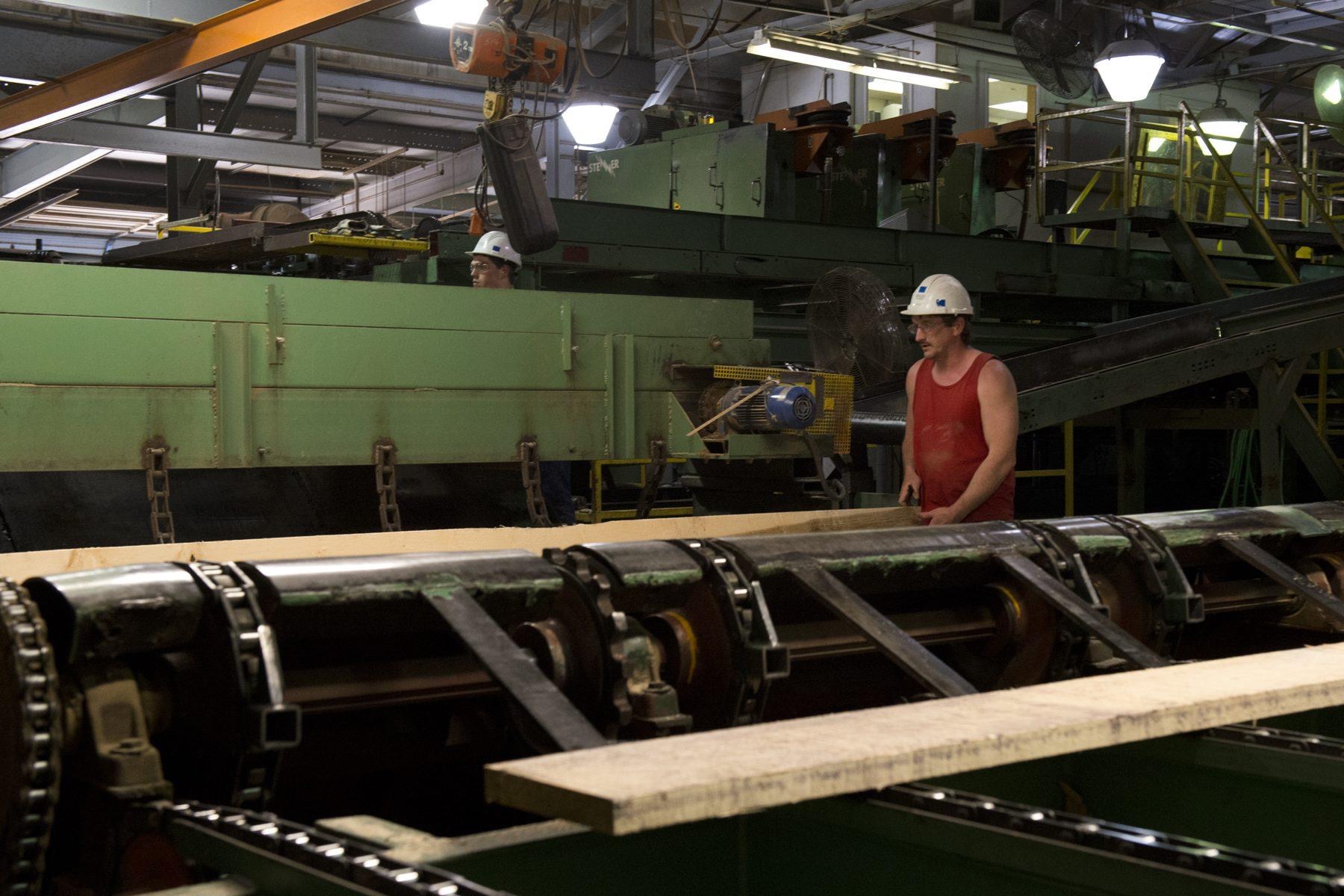
Quartersawing turns the log differently. The Center explains that it “yields fewer and narrower boards per log” and is “a slower and thus more expensive process, boosting the cost of quarter sawn lumber significantly.” Rift sawing asks even more of the log: per the Center, “rift sawn boards are narrower, available in limited quantities, and the sawing method produces a significant amount of log waste.”
Which Cut Is Most Stable, and Why?
Quartersawn lumber is the most stable in width because of how wood moves. The Wood Handbook states that “tangential shrinkage is about twice as great as radial.” The Wood Database puts it the same way, noting that tangential shrinkage is “roughly double that of the radial shrinkage” and “accounts for the lion’s share of the overall shrinkage, about two thirds.”
On a plain sawn board, the width runs roughly tangent to the rings, so the width takes the larger tangential movement. On a quartersawn board, the width runs roughly radial, so the face takes the smaller radial movement. As the Wood Database puts it, “with quartersawn lumber, the thickness of the board is doing the majority of the shrinking,” and it notes that “quartersawn boards are considered more stable than flatsawn boards.”
Real species data from the Wood Database, measured from green to oven-dry, shows the pattern clearly. White oak shrinks 5.6% radially and 10.5% tangentially, a tangential-to-radial (T/R) ratio of 1.9. Red oak shrinks 4.0% radially and 8.6% tangentially, a ratio of 2.2. Hard maple shrinks 4.8% radially and 9.9% tangentially, a ratio of about 2.1. Yellow poplar shrinks 4.6% radially and 8.2% tangentially, a ratio of 1.8.
Those figures cover the full range from freshly sawn to completely dry, so an installed board in a conditioned building moves far less. The ratio is what matters for specifying. In red oak, a plain sawn board’s width can move more than twice as much as a quartersawn board’s width for the same change in moisture. That gap is why wide panels, tabletops, door stiles, and parts held tight in a frame are natural candidates for quartersawn or rift stock.

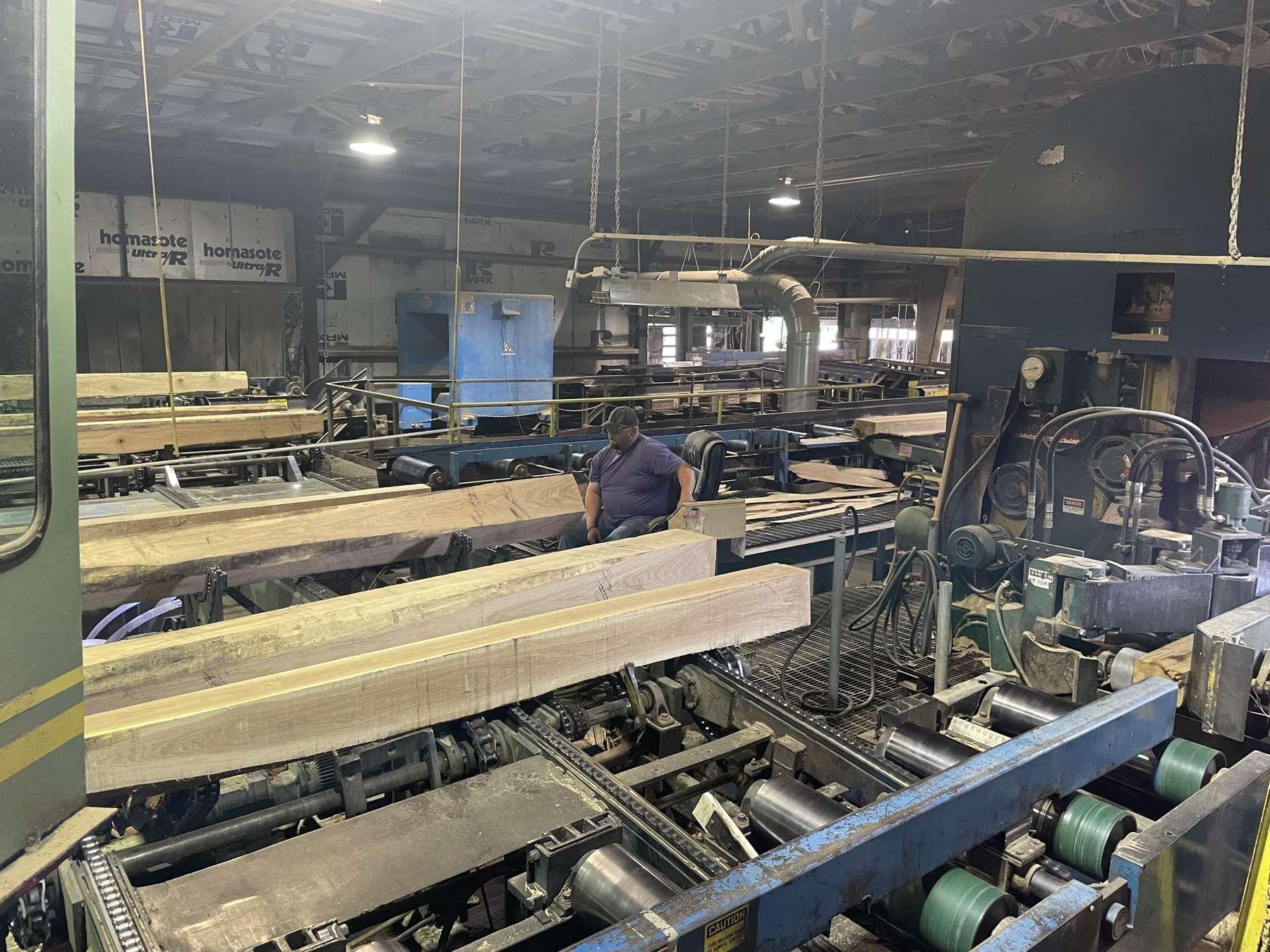
Alt text: Sawn hardwood board on a sawmill conveyor
Web filename: sawn-hardwood-board-conveyor.jpg
Original file: IMG_2898.jpg
What Does Each Cut Look Like in Oak and Other Species?
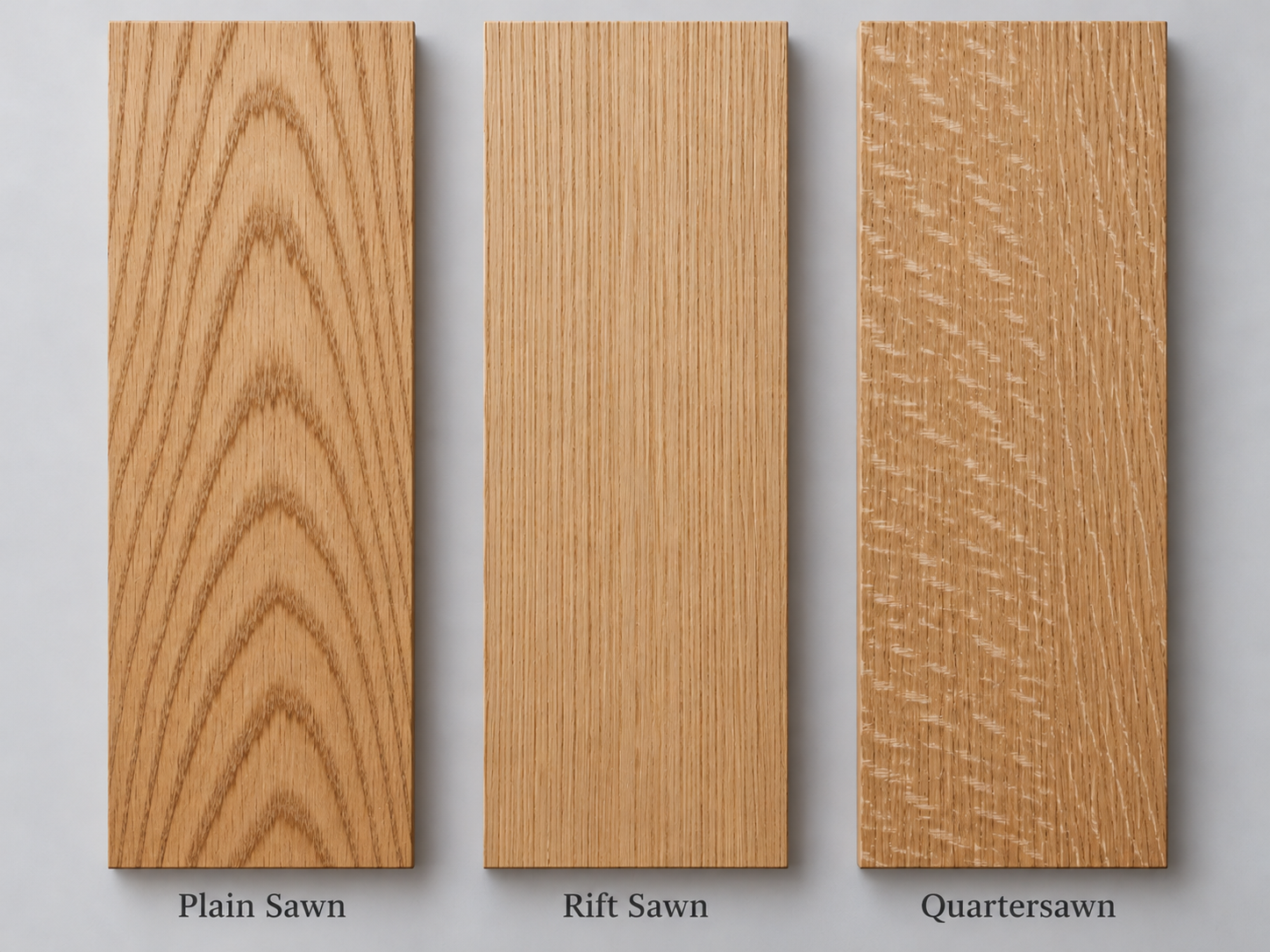
Appearance is where the three cuts differ most, and oak shows it best. The Wood Database notes that quartersawn sections of both white oak and red oak “display prominent ray fleck patterns.” The Wood Handbook describes rays as strips of cells extending radially within the tree that can reach “4 or more inches in oak.” When the saw cuts parallel to those rays, they appear on the face as flakes and ribbons of figure.
- Plain sawn oak shows cathedral arches and a broad, varied grain pattern, the familiar warmth of classic oak cabinetry and furniture.
- Quartersawn oak shows straight grain with a shimmering ray fleck crossing it, a figure found only on the quartersawn face.
- Rift sawn oak shows tight, straight, parallel grain with the rays cut at an angle that keeps fleck to a minimum. It reads as calm and linear, which suits modern and minimalist casework.
In The Blushing Bar, a red oak bar designed by Chan + Eayrs and made by Sebastian Cox Ltd for Milan design week, featured on realamericanhardwood.pro, the makers chose “crown cut boards, rather than quarter sawn, where the end grain is more pronounced and the contrast between the spring and summer material stands out more clearly.” Ray fleck is not limited to oak, either. In “From Curbside to Centerpiece,” also on realamericanhardwood.pro, Angel City Lumber founder Jeff Perry’s Los Angeles mill works California sycamore salvaged from city trees, and the article notes that “quartersawn, it reveals distinct ray flecks that give the surface a freckled, spotted character.”
In diffuse-porous species with fine rays, such as maple, cherry, and poplar, the visual difference between the cuts is subtler. There, the main reason to specify quartersawn or rift is usually stability or a consistent straight grain.
How Should You Specify Quartersawn or Rift Sawn Lumber?
Specify the cut in writing, with enough detail that a supplier and an inspector read it the same way.
Include these elements:
- Species. Name it. White oak and red oak differ in figure and in moisture behavior, and both differ from maple or cherry.
- Cut and ring angle. State the acceptable ring angle range for rift or quartersawn stock, and whether faces showing fleck are acceptable on rift parts.
- Grade. The cut and the grade are separate decisions. National Hardwood Lumber Association (NHLA) rules define grade by clear-cutting yield: FAS (Firsts and Seconds) at least 83.3% clear yield and No. 1 Common at least 66.7% clear yield. Long stiles and wide panels may call for FAS; shorter parts can often come from No. 1 Common efficiently.
- Moisture content. Match the lumber to its service environment. The Wood Handbook recommends interior woodwork average 8% moisture content in most of the United States, 6% in the dry Southwest, and 11% in damp, warm coastal regions.
- Thickness and width. Quartersawn and rift boards come out narrower than plain sawn from the same log, so confirm that widths in the design are realistic before committing to glue-up layouts.

A common approach is to specify rift or quartersawn stock where it shows or where stability matters most, such as door frames, face frames, and exposed panels, and plain sawn material for secondary parts.
Is Quartersawn Lumber Worth the Premium?
Quartersawn and rift lumber are worth the premium when the project needs width stability, a specific grain look, or both. For tabletops, wide panels, frame-and-panel doors, and furniture meant to stay tight through seasonal humidity swings, lower movement in width is a measurable advantage. For oak furniture where ray fleck is the design, it is the whole point.
For general casework, painted parts, and furniture where cathedral grain is welcome, plain sawn lumber is the efficient, entirely sound choice.
All three cuts come from the same well-managed resource. U.S. forests regrow about 1.66 cubic feet of hardwood for every cubic foot harvested, according to AHEC, and U.S. hardwood growing stock is up roughly 90% since the 1950s, per USDA Forest Service FIA data.]
How does your shop handle rift and quartersawn specs? If you write a ring angle standard into every job, or have a favorite project where the cut made the design, share it with us.
Frequently Asked Questions
Is rift sawn the same as quartersawn? No, though the terms overlap. Quartersawn lumber has growth rings close to perpendicular to the face and shows ray fleck in oak. Rift sawn lumber has rings at 30 to 60 degrees to the face, according to the American Hardwood Information Center, for straight grain with minimal fleck. Specify the ring angle you expect.
Why is quartersawn lumber more stable? Wood shrinks about twice as much tangentially as radially, according to the Wood Handbook and the Wood Database. On a quartersawn face, the width runs in the radial direction, so the board changes less in width and the thickness takes most of the movement.
Why does quartersawn oak have flecks? The flecks are rays, strips of cells that extend radially in the tree and can reach 4 or more inches in oak, according to the Wood Handbook. Quartersawing cuts parallel to them, exposing them on the face. Both white oak and red oak show prominent ray fleck when quartersawn.
Is plain sawn lumber lower quality? No. The cut and the grade are separate questions. NHLA rules grade lumber by clear-cutting yield, with FAS at least 83.3% and No. 1 Common at least 66.7%. Plain sawn lumber accounts for at least 95% of U.S. commercial hardwood production, per the American Hardwood Information Center, and is a sound choice for a wide range of furniture, cabinetry, and millwork.