

Real Wood Furniture: Why Solid Hardwood Is Worth It
The best real wood furniture is solid hardwood. Every exposed part is genuine hardwood, so its beauty and strength go all the way through. Hardwood veneer and hardwood plywood are also real wood, with genuine hardwood faces. Printed wood-look furniture uses a plastic, foil or paper surface that imitates wood grain. For pieces you want to last for generations, solid American hardwood is worth it.
Furniture is one of the few purchases that can stay with a family for decades. A dining table hosts holidays, a dresser moves from one bedroom to the next, a desk becomes a hand-me-down with a story. This guide explains what counts as real wood furniture, why solid hardwood sets the standard, and why so many designers, makers and homeowners see solid American hardwood as a lifetime choice.
What Counts as Real Wood Furniture?
Real wood furniture is furniture whose visible wood is genuine hardwood. Solid hardwood sets the standard, and hardwood veneer and hardwood plywood are real wood too.
- Solid hardwood. The American Hardwood Information Center defines solid wood as meaning that “each exposed part” of the furniture or cabinetry “is made of pieces of genuine hardwood and nothing else.” The same wood runs from the surface through every edge and corner. Think of a solid walnut table or a solid oak chair: the material of heirloom furniture.
- Hardwood veneer. The American Hardwood Information Center describes veneer as “thin slices of hardwood bonded to composite board or plywood.” Veneer is real wood cut from real logs. Makers often use it on wide panels, where it lets the figure of a single log flow across a large surface.
- Hardwood plywood. Hardwood plywood carries a genuine hardwood face. The USDA Forest Products Laboratory’s Wood Handbook lists furniture and cabinet panels among its common uses.
Many fine pieces combine these. When you have the choice, look for solid hardwood in the parts that work hardest: tabletops, chair frames, legs, drawer fronts and edges. Those are the surfaces that see daily use, and the ones where solid wood’s strength matters most.
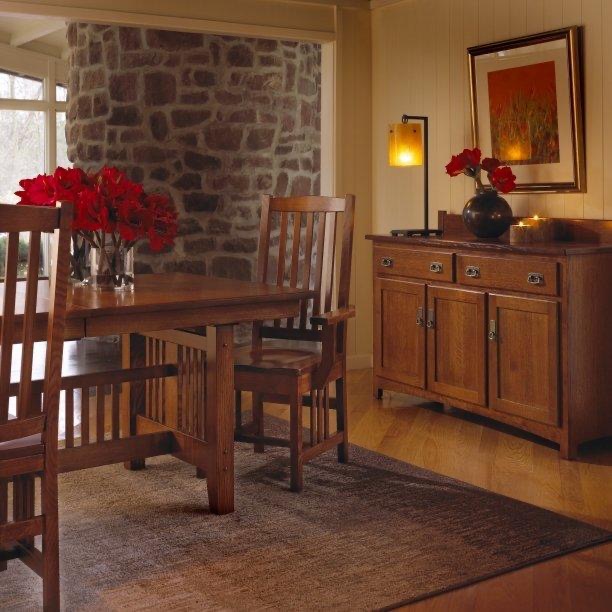
What Is Printed Wood-Look Furniture?
Printed wood-look furniture uses a surface that imitates wood. The American Hardwood Information Center describes laminate as “surfaces of plastic, foil or paper, often printed with photographs of wood grain patterns, bonded to composites such as particle board or medium density fiberboard.” Vinyl, foil and paper wraps work the same way.
These products fill a need for low-cost and ready-to-assemble pieces. The Wood Handbook describes particleboard as “the predominant material used in ready-to-assemble furniture” and notes that it is typically overlaid with other materials for decorative purposes.
The difference is what you see and touch. On solid hardwood, the grain belongs to an actual tree. On a printed surface, the grain is a picture. The American Hardwood Information Center cautions that product names like “oak, maple and cherry finish” may “simply refer to the color or photographic reproduction of the wood’s grain,” and that such wording “does not necessarily mean it is authentic, natural hardwood.” That is why the most useful thing a shopper can do is ask for solid hardwood by species name.
Why Is Solid Hardwood Furniture So Beautiful?
Solid hardwood is beautiful because no two pieces are alike. Every board carries the record of the tree it came from: its growth rings, its figure, the subtle shifts in color from heartwood to sapwood. A printed pattern can imitate a board. Solid hardwood is the board.