

The Real Renewable Lumber Carbon Benefits
Why Renewable Lumber Carbon Benefits Matter for Your Next Build
Renewable lumber carbon benefits are real, measurable, and increasingly backed by science. Here's a quick summary:
| Benefit | Key Fact |
|---|---|
| Carbon storage | Wood is \~50% carbon by dry weight, stored for the life of the structure |
| Low embodied carbon | Lumber produces just 33 kg net carbon per production ton vs. 694 kg for virgin steel |
| GHG reduction | Substituting wood for concrete and steel cuts emissions by an average of 60% |
| Renewable cycle | For every acre harvested in Washington state, nearly 99 acres of new forest grow |
| Extended storage | Harvested wood products store carbon for decades—even beyond the building's first life |
Wood is one of the only primary building materials that actively removes carbon from the atmosphere while it grows—and then continues storing that carbon after it becomes lumber, flooring, or framing inside your home.
That's a fundamentally different story than concrete, steel, or plastic. Those materials add carbon to the atmosphere when produced, with no natural offset. Wood does the opposite.
Yet many eco-conscious homeowners and designers still overlook lumber as a serious climate solution. This guide breaks down exactly how renewable wood products sequester, store, and reduce carbon — from the forest floor to your finished space.
How Wood Products Sequester Carbon
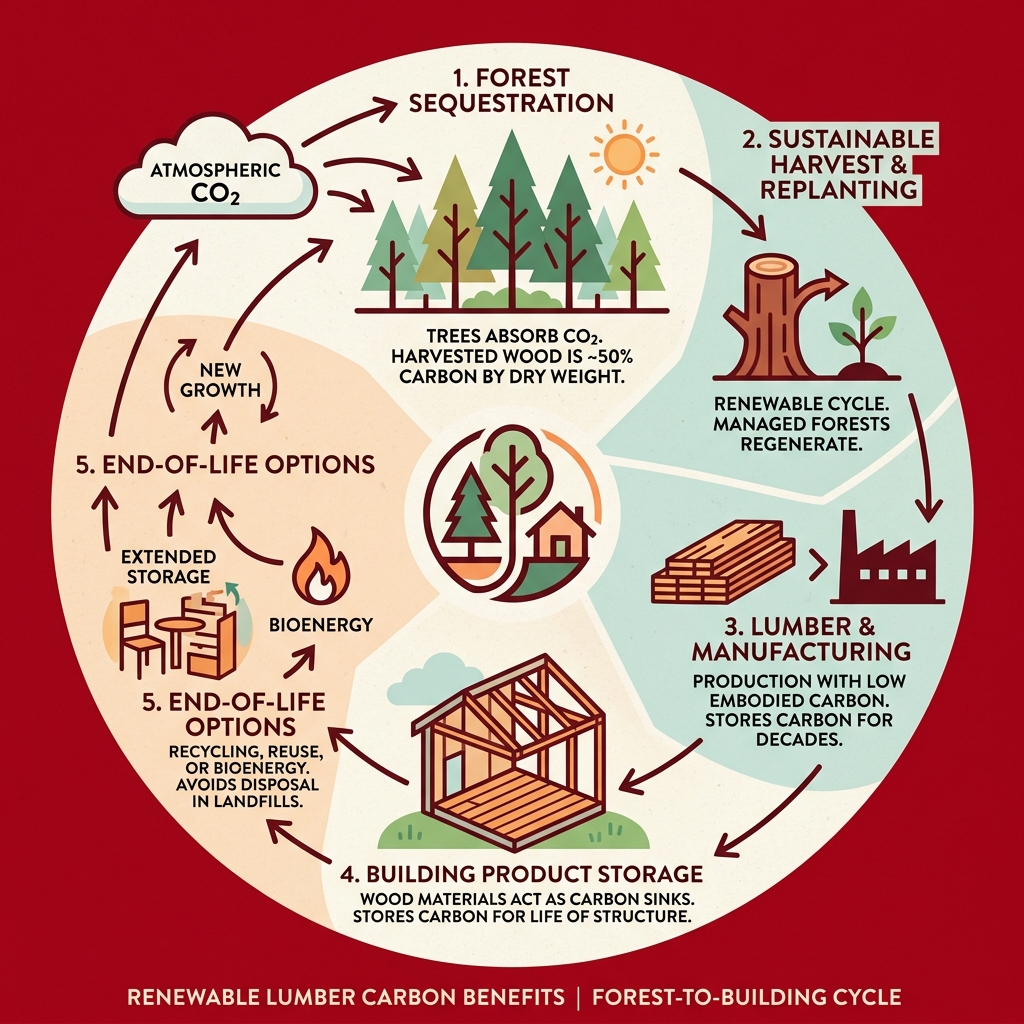
To understand the renewable lumber carbon benefits, we first have to look at how a tree actually works. Think of a tree as a natural carbon vacuum. Through the miracle of photosynthesis, trees "inhale" carbon dioxide (CO2) from the air, keep the carbon to build their trunks, branches, and roots, and "exhale" oxygen.
By the time a tree is ready for harvest, it is comprised of approximately 50% carbon by dry weight. This isn't just a temporary holding pattern; that carbon is physically locked into the wood fibers. When we harvest that tree and turn it into wood products—like the beautiful hardwood flooring or sturdy timber frames we love—that carbon stays right where it is. It doesn't magically disappear back into the atmosphere just because the tree isn't standing in the dirt anymore.
This is what scientists call "biogenic carbon." It is part of a natural, closed-loop cycle. In contrast, the carbon released from burning coal or making steel is "fossil carbon"—carbon that was buried deep underground for millions of years and is now being dumped into our atmosphere with no way to get it back.
Maximizing Renewable Lumber Carbon Benefits in Commercial Design
When we talk about "sequestration," we aren't just talking about individual boards. We're talking about the potential for our entire built environment to act as a massive carbon sink. Recent research published in the journal Nature suggests that buildings as a global carbon sink could be a game-changer for the planet.
By shifting toward wood-based construction, we achieve what is known as the "substitution effect." This is where the real magic happens. When we choose wood over carbon-heavy materials like concrete or steel, we see an average 60% reduction in greenhouse gas (GHG) emissions.
Why is the reduction so high? It’s a double win:
- We avoid the massive emissions required to manufacture steel and cement.
- We lock away carbon inside the building itself.
In fact, some mass timber and hardwood projects can even achieve "net-negative" emissions. This means the building actually stores more carbon than was emitted during its entire construction process. For those looking to dive deeper into how we manage these resources, you can find more info about sustainability on our dedicated resource page.

The Superior Carbon Profile of Renewable Lumber
One of the most compelling renewable lumber carbon benefits is the incredibly low "embodied carbon" of wood. Embodied carbon refers to the total greenhouse gas emissions associated with the entire life cycle of a material—from extraction and manufacturing to transportation and installation.
When we compare lumber to other primary structural materials, the numbers are staggering. Manufacturing lumber is the least energy-intensive process in the construction world. Take a look at the net carbon emissions per production ton:
- Lumber: 33 kg
- Recycled Steel: 220 kg
- Concrete: 265 kg
- Virgin Steel: 694 kg
As the scientific research on wood’s low embodied carbon shows, wood is the clear winner. While steel and concrete require massive furnaces and chemical reactions that belch CO2, wood is "manufactured" primarily by the sun. Our job is simply to harvest it, mill it, and bring it to your doorstep.
How Regional Supply Chains Boost Renewable Lumber Carbon Benefits
We often forget that how we get our wood matters just as much as what wood we use. This is where regional, integrated supply chains come into play. When we source American hardwoods locally, we drastically reduce the carbon footprint associated with transportation.
A study on integrated forestry supply chains found that local sourcing can reduce transportation-related emissions by as much as 93.9% compared to importing wood from overseas. By keeping the journey from the forest to the mill to the home as short as possible, we ensure that the carbon stored in the wood isn't "spent" on a long, fuel-heavy boat or truck ride.
Choosing local materials also supports the health of our own backyards. You can learn more about why this makes hardwood an age-old sustainable choice for modern builders who want to support both the environment and their local economy.
Sustainable Forest Management: The Foundation of Carbon Storage
A common question we hear is: "Isn't it better to just leave the trees alone?" While we love a pristine, untouched forest as much as anyone, the science shows that active, sustainable forest management actually provides superior renewable lumber carbon benefits over the long term.
Think of a forest like a garden. If you never prune it or harvest anything, it eventually becomes overcrowded. Old trees grow more slowly and become more susceptible to fire, disease, and decay. When an old tree dies and rots in the forest, it releases all its stored carbon back into the atmosphere.
Active management changes the math. When we harvest a mature tree, we lock its carbon into a long-lasting product like a hardwood floor. Then, vigorous young trees have room to grow in its place. These young trees are like teenagers—they have a massive appetite for carbon and grow much faster than older trees, sequestering CO2 at a higher rate.
In Washington state, for example, the management is so efficient that for every single acre harvested, there are nearly 99 acres of new forest growing. This creates a continuous cycle of carbon removal. At Real American Hardwood, we are proud that our forests grow 2.5 times faster than they are harvested. You can read more about why real hardwood is the ultimate renewable resource on our site.
Long-Term Carbon Storage in Harvested Wood Products (HWPs)
The "second life" of a tree is often longer and more productive than its first. Harvested Wood Products (HWPs) act as a vault for carbon. Whether it's the studs in your walls or the dining table where your family gathers, that wood is doing active work for the climate every single day.
But what happens when a building reaches the end of its life? The carbon storage doesn't necessarily stop there.
- Repurposing: Wood can be reclaimed and reused in new projects, extending its carbon-storing life for another century.
- Recycling: Wood fibers can be turned into paper, particleboard, or other products.
- Landfill Storage: Even if wood ends up in a landfill, it decomposes very slowly in anaerobic (oxygen-free) conditions. Studies show that wood can store carbon for decades or even centuries in a landfill, and many modern facilities capture the resulting methane to create renewable energy.
If you are a builder or architect, you might want to check out more info on calculating stored carbon to see exactly how much your project is helping the planet.
Frequently Asked Questions about Wood and Carbon
How long is carbon stored in wood buildings?
Carbon is stored for as long as the wood remains intact. For many American homes, that means a service life of 75 to 100 years or more. Some historic hardwood structures have been storing carbon for centuries! Even if a building is eventually demolished, the wood can often be recovered and repurposed, keeping that carbon out of the atmosphere for several more generations.
Does harvesting trees contribute to deforestation?
In the United States, the answer is a resounding "no." Deforestation is the permanent conversion of forest land to other uses, like parking lots or farms. Sustainable harvesting, however, is part of a cycle where forests remain forests. Because we manage our lands responsibly, our forest stocks are stable and even increasing in many regions. By providing a market for wood products, we actually give landowners a financial incentive to keep their land as forest rather than selling it off for development.
How does wood biomass energy reduce emissions?
Not every part of a tree can be turned into a high-end floor. We use the leftovers—sawdust, bark, and trimmings—to create biomass energy. This energy displaces fossil fuels like coal and oil. In fact, the Canadian forest products industry reduced its GHG emissions from fossil fuels by 51% between 2005 and 2021 by switching to bioenergy. It’s a way of ensuring that nothing goes to waste and that we are cutting our reliance on "squatter" fossil carbons.
Conclusion
The evidence is clear: renewable lumber carbon benefits are one of the most powerful tools we have to fight climate change. By choosing Real American Hardwood, you aren't just picking a beautiful material; you are participating in a cycle that removes carbon from the air, stores it in your home, and supports forests that grow 2.5 times faster than they are harvested.
As policy shifts and market incentives continue to reward low-carbon construction, wood is moving from a traditional choice to a high-tech climate solution. Whether you are building an 18-story mass timber tower or simply picking out a new hardwood floor for your living room, you are helping turn our built environment into a carbon sink.
We invite you to learn more about our commitment to sustainability and join us in building a future that is as durable and renewable as the American forest itself.