

US Forest Growth Rates: Understanding the Numbers Behind the Canopy
Why the US Forests Growth Rate Matters More Than You Think

The US forests growth rate is one of the most encouraging environmental stories you've probably never heard. Here's the short version:
The bottom line: US forests are growing significantly faster than they are being cut down.
That matters whether you're choosing building materials, thinking about carbon footprints, or simply trying to understand if American forests are healthy and renewable.
But the full picture is more nuanced. Growth rates vary widely by region. Wildfires, insects, and disease claim enormous volumes of timber every year. And policy decisions about logging on federal lands could shift these numbers considerably.
This article breaks down exactly how forest regeneration is measured, what the numbers really mean, and how all of it connects to the wood products you bring into your home.
I'm Jonathan Geyer of Real American Hardwood Company, and understanding the US forests growth rate is central to how we source and supply responsibly harvested hardwood — from standing tree to finished product. That foundation shapes everything we'll cover in the sections ahead.
Measuring the US Forests Growth Rate: Key Metrics and Ratios
To understand the health of our canopy, we have to look at more than just the number of trees. Foresters use a variety of metrics to track the "bank account" of our natural resources. Think of the total volume of wood as the principal in a savings account, and the us forests growth rate as the interest earned every year.
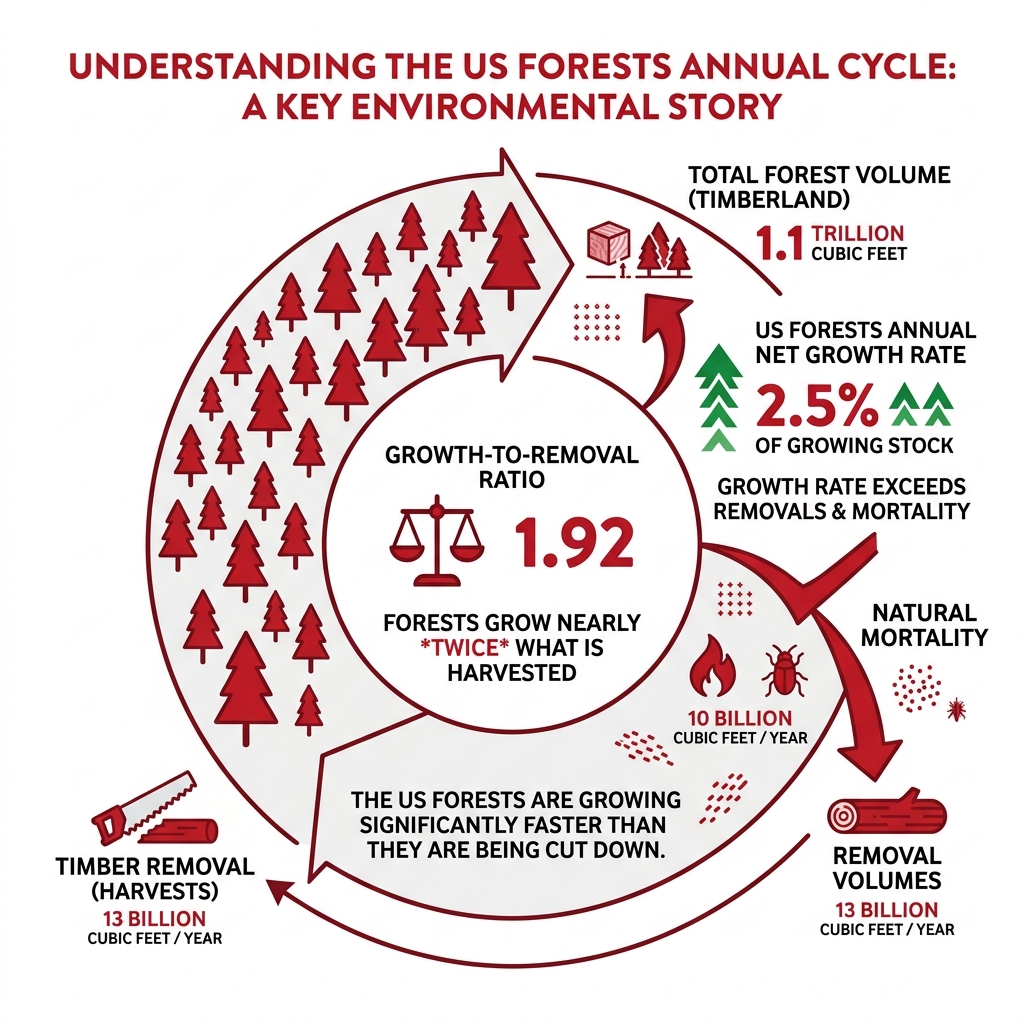
Currently, the total timber volume on U.S. timberland stands at a staggering 1.1 trillion cubic feet. Out of that, about 985 billion cubic feet is classified as "growing stock"—trees that are of commercial quality and size.
Every year, our forests add approximately 25 billion cubic feet of new wood through natural growth. This is the "net annual growth," which is the total growth minus the volume of trees that die from natural causes like old age, insects, or disease. When we look at the numbers provided by The Growing Forest | U.S. Forests at a Glance, it becomes clear that our "forest bank account" is in excellent standing.
Understanding the Growth-to-Removal Ratio
One of the most critical numbers we track is the growth-to-removal ratio. This is a simple but powerful sustainability indicator: it divides the volume of net annual growth by the volume of wood removed through harvesting or land clearing.
Nationally, that ratio is 1.92. In plain English, that means for every cubic foot of wood that is harvested or removed, nearly two cubic feet of new wood grow in its place. This stability ensures that our timberland volume isn't just holding steady—it’s actually increasing. At Real American Hardwood, we view this as the ultimate proof of Sustainability. We aren't just using a resource; we are participating in a cycle that leaves the forest more voluminous than we found it.
Calculating the Net US Forests Growth Rate
When we talk about the us forests growth rate as a percentage, we are usually referring to the net growth as a portion of the total inventory. On average, this sits at about 2.5% per year across all U.S. timberlands.
However, calculating this number requires us to account for "mortality." Nature is a busy place, and roughly 10 billion cubic feet of wood are lost annually to natural mortality. This includes everything from a single oak tree falling in a storm to large-scale losses from pests. According to Indicator 2.11: Total growing stock and annual increment, even after you subtract those 10 billion cubic feet of loss, the remaining 25 billion cubic feet of net growth still dwarfs the 13 billion cubic feet we harvest.
Regional Variations in Forest Regeneration and Productivity
If you've ever walked through a misty forest in the Pacific Northwest and then compared it to a sun-drenched oak grove in the South, you know that not all forests are created equal. The us forests growth rate changes significantly depending on where you are on the map.
In the Southern United States, the growth rate is particularly robust, averaging about 2.8%. This region is often called the "woodbasket" of the country because the warm climate and long growing seasons allow trees to reach maturity quickly. In contrast, the Rocky Mountains face different challenges. While growth still occurs, higher rates of insect disturbances and wildfires can slow the net accumulation of biomass. In the North and East, the focus shifts to Hardwood: Age-Old, Sustainable Choice species like maple, cherry, and oak, which grow at a steady, reliable pace.
Factors Influencing the US Forests Growth Rate by Region
Climate, soil health, and species composition are the three big drivers of regional productivity. For example, the Appalachian region is a standout success story. Recent data from the Appalachian Hardwood News - September 2025 indicates an incredible growth ratio of 2.82. This means in the Appalachian hardwood forests, nearly three trees are growing for every single tree that is harvested or dies naturally.
This high productivity is partly due to the amazing natural regeneration of hardwood species. Unlike some pine plantations that require intensive replanting, many hardwood forests reseed themselves or sprout from stumps, ensuring a diverse and resilient forest floor without heavy human intervention.
Historical Trends and Land Use Changes
To appreciate where we are, we have to look at where we’ve been. Before European settlement, it’s estimated that the U.S. mainland had about 1 billion acres of forest. During the 18th and 19th centuries, massive swaths of forest were cleared for agriculture as the nation expanded.
However, the 20th century marked a turning point. As farms in the East were abandoned and moved to the Midwest, forests began to reclaim the land. For the last 100 years, the total forest area in the U.S. has remained remarkably stable, even as our population has tripled. Today, we manage about 765 to 811 million acres (depending on the specific definition of "forest land" used). As noted in Forest Land-Use Change in the Conterminous United States, while urbanization continues to eat into some forest edges, the overall volume of wood in our forests is higher than it has been in decades.
The Impact of Management and Disturbances on Forest Resilience
A healthy forest isn't just one that is left alone; it's one that is managed to withstand the "big three" threats: wildfire, insects, and disease. In our National Forest System, the average annual timber mortality rate is about 1.4%. While that sounds small, it actually represents a volume of wood 2 to 8 times larger than what is harvested on those same lands.
Sustainable harvesting is actually a tool for resilience. By selectively removing certain trees, foresters can reduce "stocking" levels—essentially giving the remaining trees more room to breathe, more access to water, and better defenses against pests. This type of professional prescription helps prevent the kind of overstocked, stressed conditions that lead to catastrophic wildfires. Research in Old‐Growth Forest Area Projected to Increase on United States Federal Lands Under Alternative Future Scenarios shows that active management, combined with natural succession, is helping older forests persist even in a changing climate.
Balancing Timber Production and Conservation
The National Forest System covers about 193 million acres and is managed for "multiple use." This means these lands provide everything from timber and grazing to recreation and wildlife habitat. It’s a delicate balance.
Every year, the Forest Service and its partners plant about 5 million trees, though much of the "reforestation" happens naturally. According to By the Numbers | US Forest Service, the growth-to-drain ratio on national forests is 1.52. This proves that even on public lands where conservation is a primary goal, we are still growing significantly more wood than is being removed or lost to natural causes.
Carbon Storage and Climate Mitigation
One of the most exciting aspects of the us forests growth rate is its role in fighting climate change. U.S. forests, woodlands, and the wood products made from them currently offset about 12.4% of all greenhouse gas emissions in the United States.
When a tree grows, it captures carbon dioxide from the air and turns it into wood (biomass). When we harvest that tree and turn it into a hardwood floor or a dining table, that carbon stays locked away for decades—sometimes centuries. Meanwhile, the opening in the forest canopy allows new, young trees to grow rapidly, sucking up even more carbon. This cycle of growth and "long-lived storage" is detailed in Greenhouse Gas Emissions and Removals From Forest Land. It makes American hardwood one of the few building materials that actually helps the planet while it's being used.
Future Projections: Old-Growth and Mature Forests Through 2070
There is a common misconception that harvesting wood means we are losing our oldest, most precious forests. However, recent modeling suggests the opposite might be true.
Projections for federal lands through the year 2070 indicate that the area of old-growth forest is actually expected to increase by 19% to 27%. How is that possible? It’s all about "succession." As our vast acreage of "mature" forests continues to age, they transition into the "old-growth" category. Even when you account for increased wildfire risks and potential increases in harvesting, the rate at which trees are aging into the old-growth category is faster than the rate at which they are being lost. This trend, discussed in Projected Trends in Mature and Old-Growth Forest Area, ensures that future generations will have even more complex, biodiverse habitats than we have today.
Frequently Asked Questions about US Forest Growth
Are US forests disappearing or growing?
They are growing. While we have lost forest land historically since the 1600s, the total forest area has been stable for about 100 years at roughly 765 to 811 million acres. More importantly, the volume of wood in those forests has increased by nearly 50% since the 1950s because we grow so much more than we harvest.
How much wood is grown compared to what is harvested?
Nationally, the growth-to-removal ratio is 1.92. This means that for every 13 billion cubic feet of wood harvested or removed for development, about 25 billion cubic feet of new wood grows. We are essentially living off the "interest" of our forest resources without touching the "principal."
What is the average mortality rate of trees in national forests?
The average annual mortality rate is about 1.4%. Interestingly, in many national forests, the amount of wood that dies from fire, insects, and disease is 2 to 8 times higher than the amount of wood harvested by humans. This highlights the importance of active management to salvage dead wood and reduce fuel for wildfires.
Conclusion
The numbers don't lie: the us forests growth rate is a testament to the resilience of nature and the effectiveness of modern sustainable forestry. From the 2.5% annual net growth to the carbon-capturing power of our hardwood stands, American forests are a thriving, renewable resource.
At Real American Hardwood, we are proud to provide products that are part of this virtuous cycle. When you choose real wood, you aren't just getting a beautiful, durable material for your home; you are supporting a system that keeps our forests standing, growing, and breathing. Our forests are a massive carbon sink and a provider of essential ecosystem services, and thanks to responsible management, they are poised to grow even stronger in the decades to come.
Discover the benefits of Real American Hardwood and see why choosing the real thing is the best choice for your home and the planet.