

American Red Oak vs. White Oak: Which Hardwood Should You Choose?
Red Oak vs. White Oak: The Two Most Important Hardwoods for Interior Design
Wood for interior design is one of the most impactful choices you can make when building or renovating a space. And when it comes to American hardwoods, two species dominate the conversation: Red Oak and White Oak.
Here is a quick comparison to help you decide:
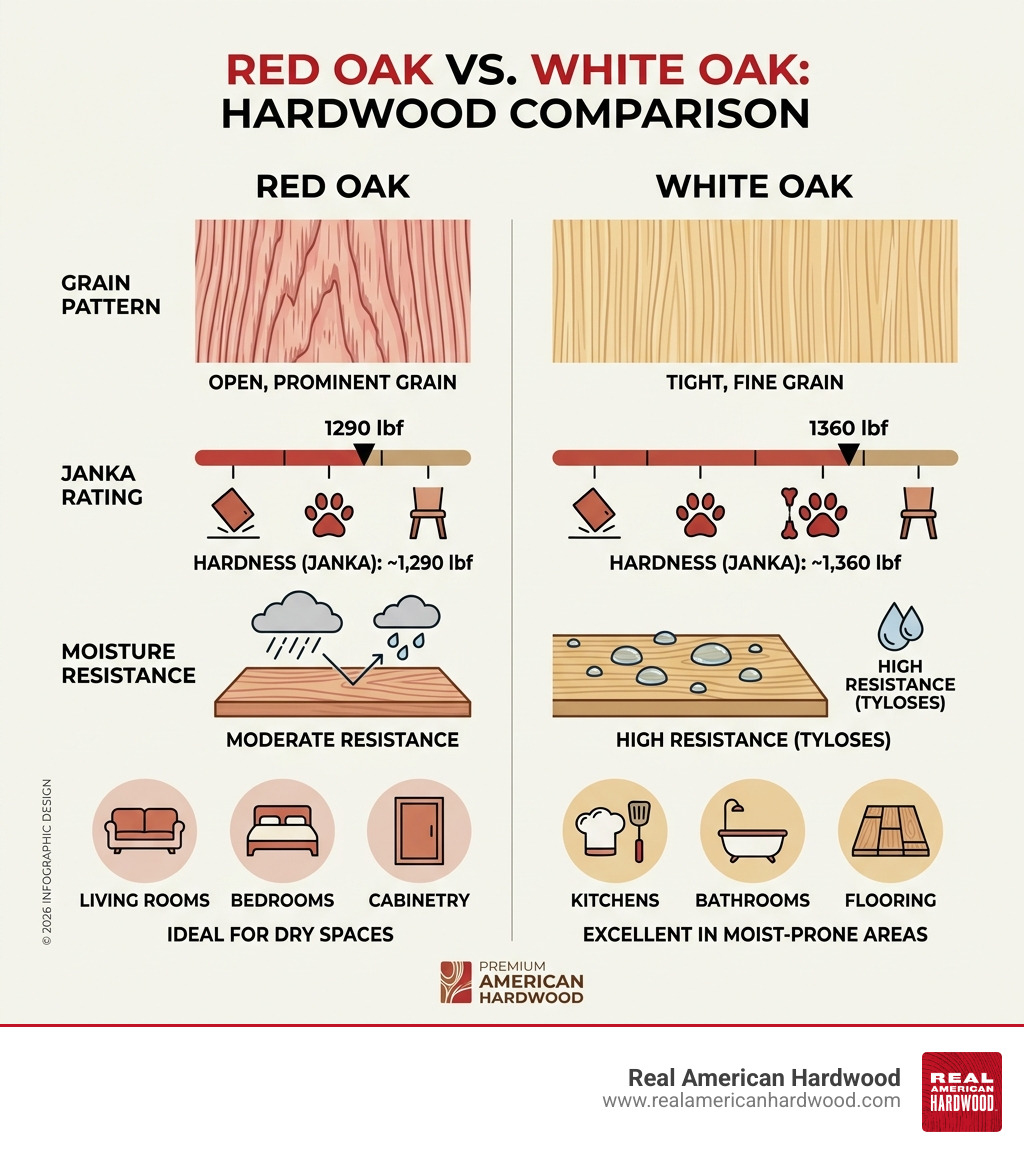
| Feature | Red Oak | White Oak |
|---|---|---|
| Color | Warm pinkish-red tones | Pale yellow to light tan |
| Grain | Open, prominent grain | Tighter, finer grain |
| Moisture resistance | Moderate | High (due to tyloses) |
| Best uses | Living rooms, bedrooms, cabinetry | Kitchens, bathrooms, flooring |
| Hardness (Janka) | ~1,290 lbf | ~1,360 lbf |
| Sustainability | Highly abundant | Widely available |
| Cost | Slightly lower | Slightly higher |
Both are durable, beautiful, and sourced from responsibly managed American forests. But they perform differently depending on where and how you use them. The sections below break down exactly what sets them apart.
I'm Jonathan Geyer, a specialist collaborating with the Real American Hardwood Coalition, and with years of experience sourcing, milling, and distributing premium American hardwoods for wood for interior design applications — from residential flooring to custom furniture — I will walk you through everything you need to know to make the right choice. Read on for a full breakdown of both species across aesthetics, performance, health, and sustainability.
The Fundamentals of Wood for Interior Design: Hardwoods vs. Softwoods
Before we dive into the "Battle of the Oaks," we need to understand what makes hardwood the premier choice for your home. In wood for interior design, we often hear the terms "hardwood" and "softwood." You might think this refers to how easily the wood dents when you drop a cast-iron skillet, but it actually describes the tree’s biology.
Hardwoods come from deciduous trees (angiosperms) that lose their leaves annually, like our beloved oaks, maples, and walnuts. Softwoods come from conifers (gymnosperms), like pine and cedar. While some softwoods are technically "harder" than some hardwoods, the structural density and complex grain patterns of American hardwoods are what make them the gold standard for longevity.
To help designers and homeowners navigate quality, the National Hardwood Lumber Association (NHLA) provides a grading system. When you are looking for the "best of the best" for your furniture or cabinetry, you want FAS (First and Seconds). This grade ensures you are getting large, clear cuttings with minimal knots—essentially the "supermodel" of lumber. For a more rustic, storied look, "Common" grades offer character marks that tell the history of the forest.
We also measure durability using the Janka hardness scale. This test measures the force required to embed a small steel ball halfway into the wood. As we noted, Red Oak sits at about 1,290 lbf and White Oak at 1,360 lbf. To put that in perspective, these woods are built to handle decades of foot traffic, energetic pets, and the occasional kitchen mishap.
For a deeper dive into how these categories function, you can explore The Different Types of Wood and Their Uses in Design and ... or check out our comprehensive Hardwood Species Guide.
Selecting the Right Wood for Interior Design for High-Traffic Areas
When we talk about high-traffic areas like kitchens and living rooms, we aren't just looking for beauty; we are looking for a material that can take a punch (or a dropped juice box). Hardwood's impact resistance is legendary. Unlike synthetic laminates that chip or peel, solid hardwood can be sanded and refinished multiple times over its century-long lifespan.
In the kitchen—the heart of the home—durability is non-negotiable. We recommend species that balance hardness with stability. While both oaks are fantastic, many designers lean toward White Oak for kitchen flooring because its density helps it resist the wear and tear of daily meal prep. If you’re curious about which woods play best with your kitchen island or custom pantries, see our guide on the Perfect Hardwood Species for Your Kitchen.
American Red Oak vs. White Oak: Aesthetics and Performance
Now, let’s get into the nitty-gritty. If you were to look at a Red Oak board and a White Oak board side-by-side, the first thing you’d notice is the "vibe."
Red Oak is the classic American choice. It features warm, pinkish-to-red undertones and a bold, open grain. It’s "porous," which sounds like a bad thing, but for a designer, it’s a dream. Those open pores allow Red Oak to take stains exceptionally well. Whether you want a deep espresso finish or a vibrant modern hue, Red Oak absorbs the pigment evenly, highlighting its dramatic grain patterns.
White Oak, on the other hand, is the darling of contemporary and Scandinavian design. It offers a cooler, more neutral palette of tans and pale yellows. Its grain is tighter and more linear, especially when "rift-sawn" or "quarter-sawn." This creates a sophisticated, architectural look that feels right at home in a minimalist loft or a high-end coastal retreat.
Beyond looks, there is a chemical difference: Tannins. White Oak has a much higher tannin content than Red Oak. This natural acidity makes it more resistant to rot and insects. Historically, this is why White Oak was the go-to for boat building and wine barrels—it literally seals itself off from the elements.
As noted in the research from TIMBER INDOOR, solid wood is an expression of the life of a tree. Every knot and grain swirl is a record of the weather, minerals, and sunshine that tree absorbed over 30 to 100 years. When you choose oak, you aren't just buying a product; you are bringing a piece of natural history into your home.

Moisture Resistance and Wood for Interior Design in Bathrooms
Can you put wood for interior design in a bathroom? It’s a question we get all the time. The answer is a resounding yes, provided you choose the right species and finish.
This is where White Oak takes the trophy. White Oak contains a microscopic cellular structure called tyloses. Think of tyloses as tiny, natural "bubbles" that clog the wood's vascular tubes. Because these tubes are blocked, liquid cannot easily travel through the wood. This makes White Oak incredibly resistant to water penetration and rot.
While we still wouldn't recommend using it as the floor of your shower, White Oak is an elite choice for bathroom vanities, wall paneling, and even flooring in well-ventilated bathrooms. It brings an organic warmth to a space that is usually dominated by cold tile and porcelain. For more tips on making this work, check out our guide on Selecting the Perfect Hardwood Species for Your Bathroom.
Health and Wellness: Why Hardwood is the Superior Choice
In May 2026, we are more conscious than ever of how our homes affect our health. We spend roughly 90% of our time indoors, and the materials we surround ourselves with matter. Wood for interior design isn't just an aesthetic choice; it’s a wellness choice.
The concept of biophilic design—incorporating natural elements into our built environment—is supported by research cited by the NHLA showing that seeing and touching natural wood can actually reduce cortisol levels and lower heart rates. There is a "haptic" quality to wood; it feels warm to the touch because it is a natural insulator, a property documented by the USDA Forest Service, unlike stone or tile which siphons heat away from your body.
But the most significant impact is on Indoor Air Quality (IAQ). Synthetic floorings like carpet and some vinyls can trap dust, dander, and allergens. They can also "off-gas" Volatile Organic Compounds (VOCs) for years after installation. Real American Hardwood, when finished with modern, water-based or natural oil finishes, is a clean, inert material, as recognized by GREENGUARD and NHLA standards.
Health Summary: Hardwood and Indoor Air Quality
If you are designing for a family with allergies or asthma, hardwood is the clear winner. Here is why:
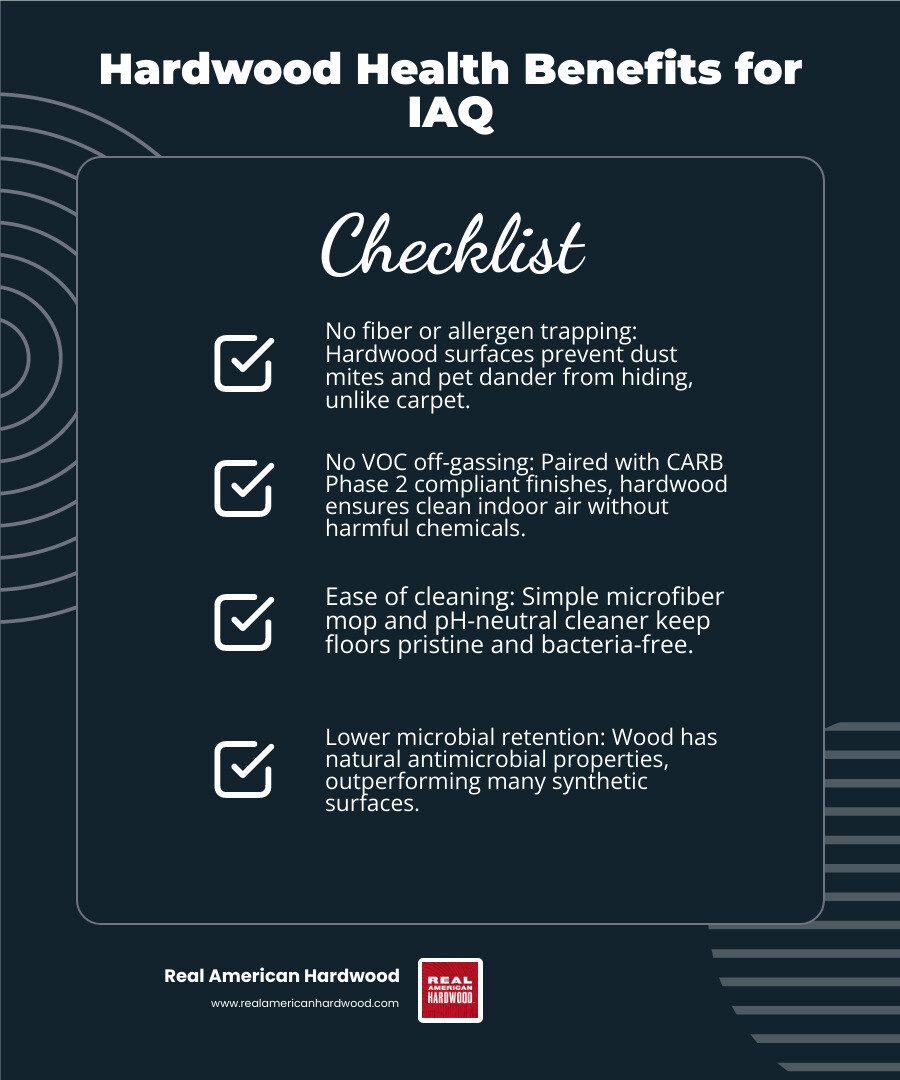
- No fiber or allergen trapping: Unlike carpet, which acts as a giant sponge for dust mites and pet dander, hardwood provides a smooth surface where allergens have nowhere to hide.
- No VOC off-gassing: Real American Hardwood is a natural product. When paired with CARB Phase 2 compliant or GREENGUARD certified finishes, it ensures your family isn't breathing in harmful chemicals.
- Ease of cleaning and maintenance: A simple microfiber mop and a pH-neutral cleaner are all you need to keep your floors pristine and bacteria-free.
- Lower microbial retention: European studies, such as those from the University of Munich, have shown that wood surfaces can have natural antimicrobial properties, making them more hygienic than many synthetic alternatives.
Sustainability and Environmental Impact of American Hardwoods
We often hear the misconception that using wood is bad for the environment. In reality, the opposite is true—provided you are using Real American Hardwood.
Our North American hardwood forests are a "truly renewable" resource. We don't just "replant" trees; our forests naturally regenerate. This means that when a mature tree is harvested, the opening in the canopy allows sunlight to reach the forest floor, triggering the growth of thousands of seedlings that have been waiting in the "seed bank" for years.
Here is the most important statistic you’ll read today: North American hardwood forests are growing at a rate 2.5 times faster than they are being harvested. According to USDA Forest Service data, the volume of hardwood in our forests has increased significantly over the last 60 years.
Furthermore, wood is a carbon-sequestering powerhouse. Trees absorb CO2 as they grow, and that carbon remains "locked" inside the wood for as long as the furniture or flooring exists in your home—a process recognized by the USDA as a critical tool for climate mitigation. Choosing wood is a way to store carbon in your living room. As noted by TIMBER INDOOR, solid wood is a sustainable expression of life that supports the health of our planet.

Sustainable Sourcing of Wood for Interior Design
When you choose wood for interior design, look for certifications like FSC (Forest Stewardship Council) or SFI (Sustainable Forestry Initiative). These labels ensure that the wood was harvested using practices that protect water quality, wildlife habitats, and biodiversity.
American Red Oak is actually the most abundant hardwood species in the U.S., making it an incredibly sustainable and cost-effective choice. White Oak is also widely available, though its slower growth rate and high demand make it a slightly more precious resource. By choosing these domestic species, you are also reducing the carbon footprint associated with shipping exotic woods halfway across the globe. You can learn more about this in our article on Hardwood in Home Design.
Frequently Asked Questions about Wood for Interior Design
Does hardwood improve indoor air quality?
Absolutely. Hardwood floors do not trap dust, pollen, or other allergens. Furthermore, because solid wood is a natural material, it does not emit harmful VOCs. To ensure the best IAQ, we recommend using finishes that meet GREENGUARD or CARB Phase 2 standards. This ensures your home remains a healthy sanctuary for your family.
Which oak is better for kitchens and bathrooms?
While both are durable, White Oak is the superior choice for moisture-prone areas like kitchens and bathrooms. Its unique cellular structure (tyloses) acts as a natural water barrier, and its high tannin content provides extra protection against rot. Red Oak is fantastic for living rooms and bedrooms but requires more careful sealing in wet environments.
Is American hardwood a sustainable material?
Yes, it is one of the most sustainable materials on earth. According to USDA Forest Service data, U.S. hardwood forests grow 2.5 times faster than they are harvested due to natural regeneration and strict forestry laws. Unlike plastic-based flooring that ends up in a landfill, hardwood is a renewable resource that captures carbon and can last for generations.
Conclusion
At the Real American Hardwood Coalition, we believe that your home should be a reflection of your values. Whether you choose the warm, inviting tones of Red Oak or the sleek, resilient nature of White Oak, you are making an investment in the five pillars of great design: Home, Health, Durability, Value, and Environment.
Red Oak offers unmatched versatility and a classic American aesthetic, while White Oak provides modern elegance and industry-leading moisture resistance. Both species bring the "biophilic" benefits of nature into your daily life, improving your air quality and your peace of mind.
When you choose wood for interior design, you aren't just picking a color palette—you're choosing a legacy. You're choosing a material that grows more beautiful with age, stores carbon, and supports the vibrant, naturally regenerating forests of America.
Discover the Health and Sustainability Benefits of Real American Hardwood. Whether you are a homeowner, an architect, or a designer, there is no substitute for the real thing. To explore more species or find inspiration for your next project, visit our Build Your World resource center. Let’s build something that lasts.