

Environmentally Friendly Cypress Siding is the Natural Choice for Your Home
Why Environmentally Friendly Cypress Siding Belongs on Your Home
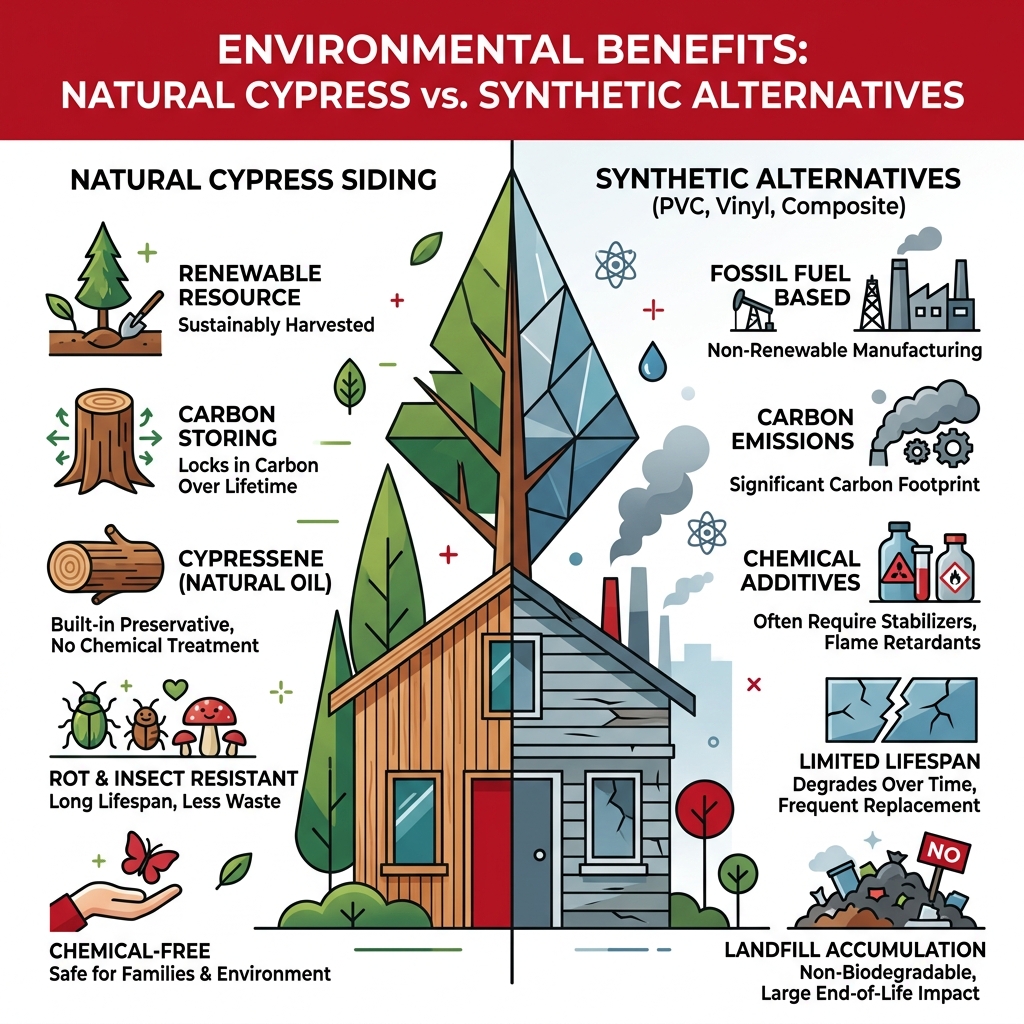
Environmentally safe cypress siding is one of the best natural building choices available to eco-conscious homeowners today. Here's a quick summary of why:
- Natural preservative oil (cypressene): Helps protect the wood without chemical pressure treatment
- Rot and insect resistant: Supports a long service life with less maintenance
- Renewable resource: Can be responsibly harvested as part of healthy forest management
- Carbon storing: Keeps carbon locked in the wood over its lifetime
- Chemical-free: A safer choice for your home and the surrounding environment
Choosing siding for your home is about more than just looks. It's about what that material does to the planet and how long it lasts before it ends up in a landfill.
Many homeowners assume eco-friendly means sacrificing durability. With cypress, that's simply not true.
Cypress heartwood naturally produces its own preservative oil. That means it resists rot, decay, and insects—without being treated with harsh chemicals. It's a wood that protects itself, and in doing so, protects your home and the environment around it.
Whether you're building new or replacing tired siding, cypress offers a rare combination: genuine beauty, real durability, and a clean environmental footprint.
The Inherent Properties of Cypress Siding
When we talk about environmentally friendly cypress siding, we are highlighting a material that performs a "magic trick" of sorts. Most species of wood require heavy industrial processing and chemical pressure treatments to survive outdoors. Cypress, however, comes pre-equipped for the job.
The secret lies in its chemistry. As a cypress tree grows, it generates a natural preservative oil known as cypressene. This oil saturates the heartwood—the dense, inner portion of the log—acting as a built-in shield against the elements. Because these oils are produced by the tree itself, there is no need for the toxic copper-based or arsenic-based infusions often found in "treated" lumber.
This inherent resistance makes it a premier choice for Cypress in Hill Country Home Design, where homes must withstand intense heat and variable humidity. These trees have spent millennia adapting to the high-moisture conditions of the American Southeast, developing a cellular structure that resists saturation. This evolutionary history is what makes cypress siding so uniquely suited for modern residential applications where moisture management is the primary concern for longevity. When you choose cypress, you aren't just buying wood; you're buying a biological defense system that has evolved over millions of years to thrive in wet, swampy environments.
Natural Durability: Protection Without the Toxins
For many homeowners, the word "durability" brings to mind plastic or chemically treated wood. But environmentally friendly cypress siding offers a much cleaner path. Its resistance to rot and decay is legendary, often outperforming species like cedar in head-to-head longevity tests.
Inherent Rot Resistance
Because cypressene oil stays trapped within the wood fibers even after the tree is harvested and milled, the wood remains resistant to the elements and rot. This is particularly vital in coastal or high-humidity regions where moisture is a constant threat. While other materials might swell, buckle, or begin to soften within a few years, cypress remains dimensionally stable.
This dimensional stability is a critical factor for homeowners. Unlike many synthetic composites that expand and contract significantly with temperature swings—putting stress on fasteners and causing unsightly gaps—cypress maintains its shape. This means your siding stays tight and your home's thermal envelope remains protected against the elements year-round.
Natural Insect Repellent
It isn't just water that cypress fights off; it’s also a natural deterrent for wood-boring insects. Termites and carpenter bees find the natural oils in cypress unappealing. By installing cypress, you significantly reduce the risk of the "woodpecker effect"—where birds peck holes into your siding to reach the bee larvae nesting inside.
Research from institutes like BM Trada, which tests timber stability and coating performance, confirms that high-quality wood species offer superior performance when exposed to wet and ambient cycles. Furthermore, BRE assessments often categorize high-durability timbers in "Class 1" ratings, noting that their service life can extend for decades when properly specified.
Sustainability and the Lifecycle of Real American Hardwood
At Real American Hardwood, we believe that true sustainability isn't just about "doing less harm"—it’s about choosing materials that actively benefit the planet. Cypress is a cornerstone of this philosophy.
Carbon Sequestration
Trees are nature’s carbon capture machines. As cypress trees grow, they soak up CO2 from the atmosphere and lock it into their cellular structure. When that wood is turned into siding for your home, that carbon remains stored for the life of the building. Choosing wood over energy-intensive materials like vinyl, steel, or concrete (which release massive amounts of CO2 during production) is a responsible, climate-friendly choice.
This concept is known as "low embodied energy." It takes far less fuel and industrial processing to harvest and mill a cypress board than it does to manufacture a vinyl or fiber-cement alternative. By selecting cypress, you are effectively reducing the total carbon footprint of your construction project from day one.
A Truly Renewable Resource
We are proud to support a domestic forestry industry where forests are growing 2.5 times faster than they are being harvested. This means that for every cypress board used on your home, more than two boards' worth of new growth is already taking its place in the forest. You can learn more about these efforts on our Sustainability page.
Long-Term Performance of Environmentally Safe Cypress Siding
Cypress isn't a "temporary" fix. With a service life that can reach 60 years or more under the right conditions, it provides an incredible return on investment.
- Lifespan Expectations: With basic maintenance, cypress siding can easily last the lifetime of the homeowner.
- Weathering: If left unfinished, cypress undergoes a beautiful transformation, eventually turning a stately, silvery-gray.
- Dimensional Stability: Cypress has a very low shrinkage rate, meaning it is less likely to warp, twist, or pull away from fasteners compared to other species.
Aesthetic Versatility and Maintenance
One of the reasons architects love environmentally friendly cypress siding is its "chameleon" quality. It fits just as well on a rustic mountain cabin as it does on a sleek, modern beachfront estate.
Cypress typically features a beautiful, fine grain and "honey-like" hues that range from light straw to deep reddish-brown. For those looking for something truly unique, pecky cypress offers a textured, "distressed" look caused by a natural fungus that creates deep furrows in the wood. Once the wood is dried, the fungus disappears, leaving behind a high-end, artistic pattern that is highly sought after for accent walls and luxury exteriors.
We've seen this versatility in action in projects like Cypress: Something Old, Something New Rejuvenates Long Island Home, where the wood was used to bridge the gap between traditional charm and modern durability.
Finishing Environmentally Safe Cypress Siding for Maximum Longevity
While cypress is tough enough to go "naked," most homeowners choose a finish to preserve its original color or match a specific design palette.
- Cleaning Protocols: Before finishing, always wash the wood with a mild bleach-and-water solution to remove any surface dust or mildew. Let it dry for at least a week before applying any product.
- Oil-Based Stains: With cypress, oil-based, semi-transparent stains perform best. These penetrate deep into the fibers, allowing the wood to "breathe" while repelling liquid water.
- UV Inhibitors: Sunlight is the primary cause of wood fading. Ensure your sealer or stain contains UV inhibitors to protect the wood from "sunburn."
- Back-Priming: For the best results, apply your finish to all sides of the board (including the back and ends) before installation. This seals the wood completely and prevents moisture from creeping in from behind.
Frequently Asked Questions about Environmentally Safe Cypress Siding
Is cypress siding naturally resistant to decay and insects?
Yes! Cypress heartwood produces a natural oil called cypressene. This oil acts as a built-in preservative, making the wood highly resistant to rot, decay, and wood-boring insects like termites and carpenter bees without the need for chemical pressure treatments.
How long does cypress siding last?
When properly installed and maintained, cypress siding can last 60 years or more. Even when left unfinished to weather naturally, its inherent durability allows it to outperform many other siding materials over the long term.
Is cypress wood considered a sustainable building material?
Absolutely. Cypress is a renewable resource harvested from American forests that are managed for long-term health. In the United States, hardwood forests are currently growing at more than twice the rate of harvest, making it a carbon-negative choice for your home’s exterior.
Conclusion
Investing in environmentally friendly cypress siding is a vote for a more sustainable future. You get a home that is naturally resilient, incredibly beautiful, and free from the toxic chemicals found in many synthetic or treated alternatives.
By choosing real wood, you are supporting American landowners who keep our forests as forests, ensuring that these natural resources continue to capture carbon and provide wildlife habitats for generations to come.
Ready to start your project? Discover the right wood for your project in our Hardwood Species Guide and see why cypress is the natural choice for the modern home.