

Pro Tips and Techniques for a Flawless Hardwood Floor Installation
Why Proper Hardwood Flooring Installation Makes All the Difference
The most important hardwood flooring installation tips you need to know, at a glance:
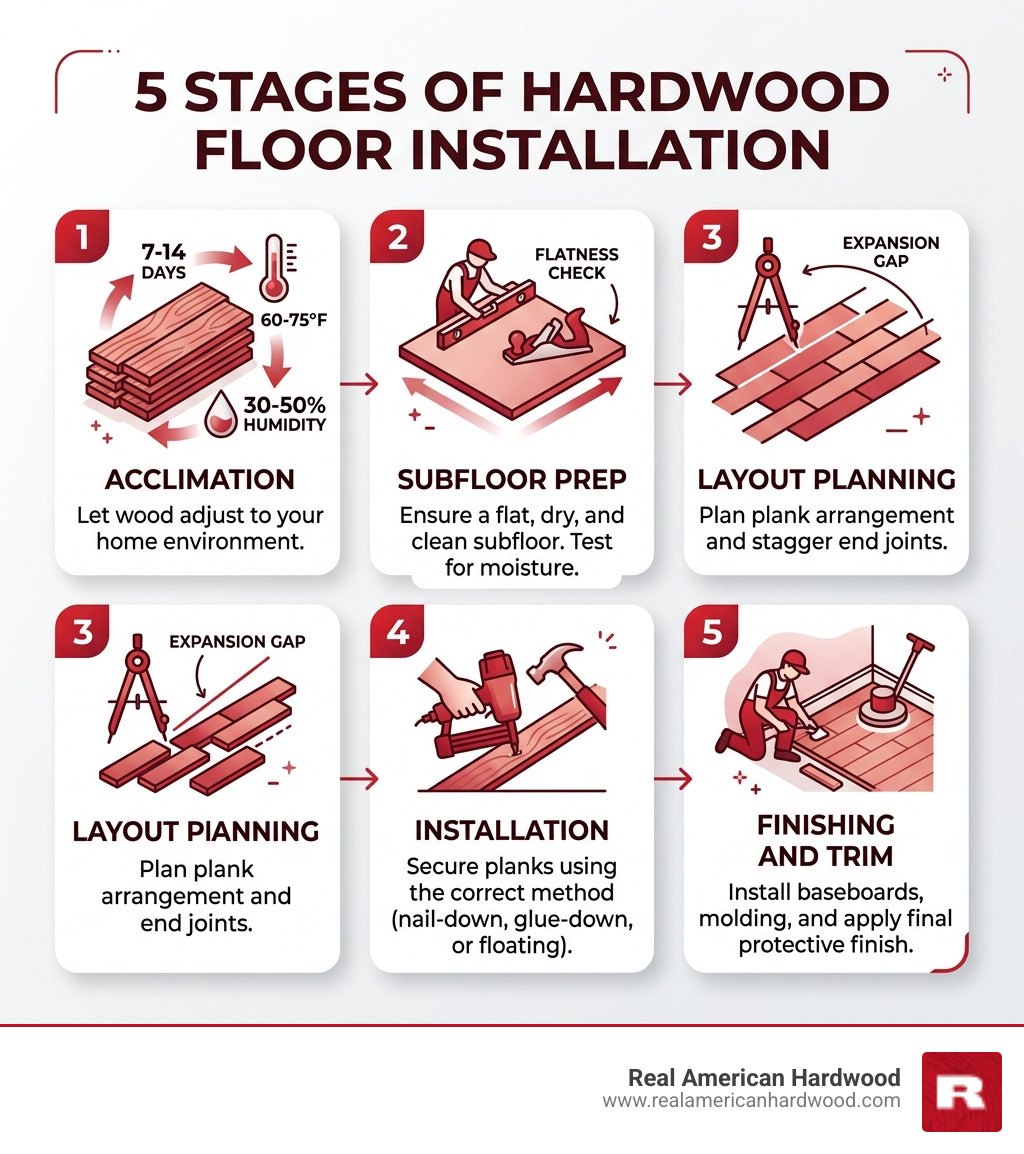
- Acclimate your wood for 7–14 days at 60–75°F and 30–50% humidity before starting
- Prep your subfloor so it's flat within 3/16 inch per 10 feet, dry, and structurally sound
- Choose the right method — nail-down for wood subfloors, glue-down or floating for concrete
- Plan your layout with a chalk line, stagger end joints 6–12 inches, and avoid H-patterns
- Leave expansion gaps of at least 1/2 inch around all walls and fixed objects
- Buy 10–15% extra material to account for cuts and waste
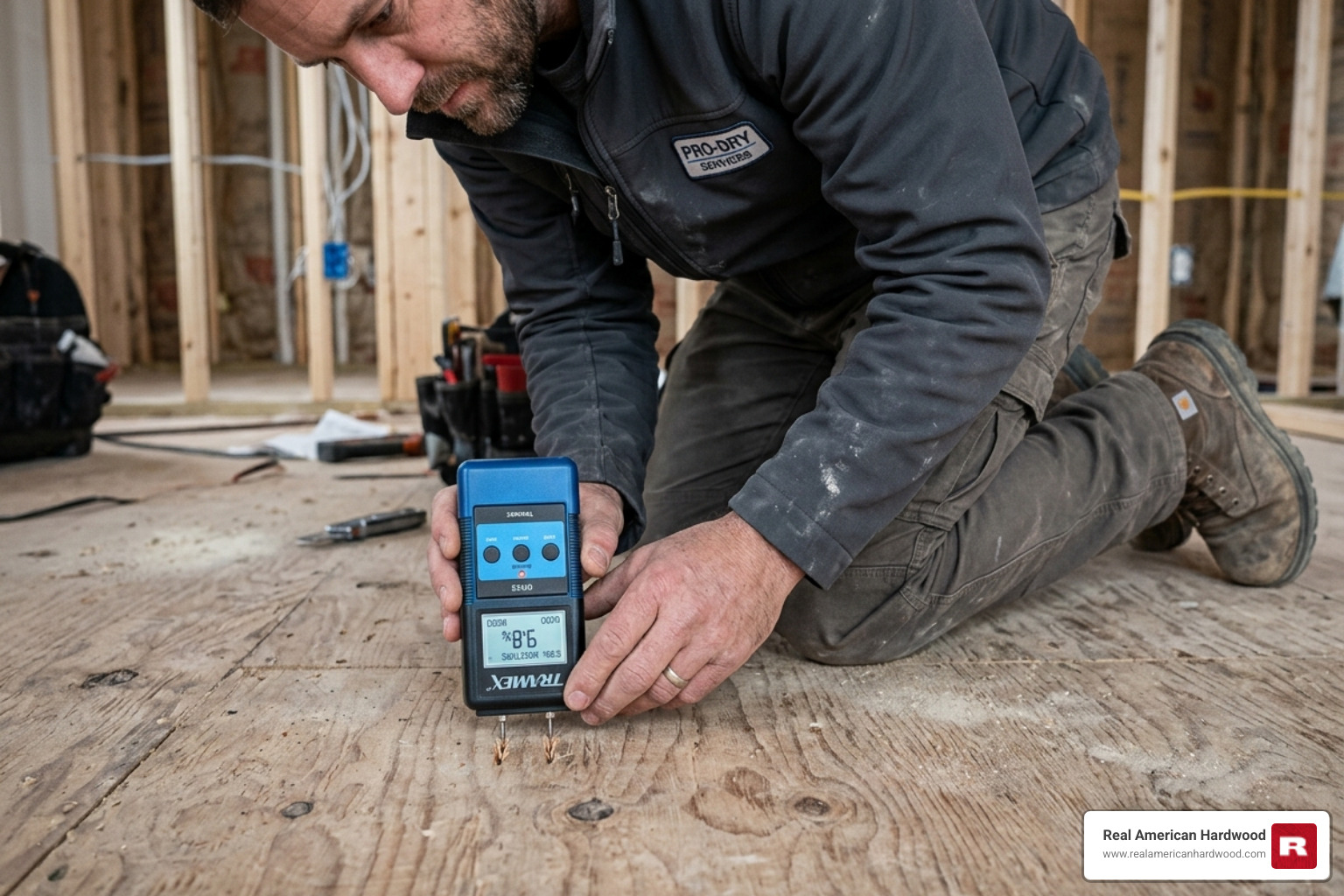
- Never skip moisture testing — wood and subfloor moisture should be within 2% of each other
A perfectly milled plank of white oak can buckle, gap, squeak, or cup within months. Not because of the wood itself—but because of how it was installed.
Installation is where most hardwood floors succeed or fail. The material is rarely the problem. Rushed prep work, skipped moisture tests, or the wrong fastener spacing are what cause headaches years down the road.
The good news? With the right knowledge and a clear plan, you can avoid every one of those pitfalls. Whether you're a hands-on DIYer or preparing to hire a crew, understanding the process from start to finish puts you in control of the outcome.
Material Selection and Subfloor Preparation
Before you ever pick up a hammer, the success of your project is determined by the choices you make in the showroom and the work you do on your hands and knees checking the subfloor. At Real American Hardwood, we advocate for the use of sustainable, domestic species, but even the highest quality wood requires a stable foundation.
| Feature | Solid Hardwood | Engineered Hardwood |
|---|---|---|
| Composition | 100% solid wood plank | Layered wood/plywood core |
| Refinishing | Multiple times (can last 70+ years) | Limited (1–2 times depending on wear layer) |
| Moisture Resistance | Lower (prone to expansion/contraction) | Higher (more stable in humidity) |
| Installation Level | On or above grade | On, above, or below grade (basements) |
| Method | Nail-down or staple-down | Glue, float, or nail |
When browsing, check out our Hardwood Species Guide to find the right Janka hardness for your home’s traffic levels. If you are considering modern construction methods, engineered wood flooring might be the answer for more challenging environments.
Understanding Solid vs. Engineered Hardwood
One of the most frequent hardwood flooring installation tips we share involves matching the wood type to the environment. Solid hardwood is a single piece of wood from top to bottom. Its primary advantage is longevity; it can be sanded and refinished multiple times. However, because it is a natural, "living" material, it reacts to changes in humidity levels.
Engineered hardwood, on the other hand, features a top veneer of real wood bonded to a cross-layered plywood core. This construction makes it much more resistant to warping and cupping. If you are installing over a concrete slab or in a finished basement (below grade), engineered wood is almost always the safer bet.
Critical Subfloor Requirements and Acclimation
We often say the subfloor matters more than the flooring itself. If your subfloor isn't right, your expensive new planks will eventually tell you about it with squeaks and gaps.
- Flatness Standards: Your subfloor must be flat within 3/16 inch in a 10-foot radius or 1/8 inch in 6 feet. Use a long straightedge to find high spots (which need sanding) and low spots (which need filling with a high-quality leveling compound).
- Acclimation: This is the step most people rush, and it’s the most dangerous to skip. Hardwood should acclimate in the room where it will be installed for at least 7 to 14 days.
- HVAC Stabilization: Your home’s heating and cooling systems should be operational for at least 7 days prior to installation. Maintain a consistent temperature between 60–75°F and relative humidity between 30–50%.
Hardwood Flooring Installation Tips for Every Method
The method you use depends entirely on your subfloor and the type of wood you've selected, often following industry standards set by the National Wood Flooring Association. When Choosing the Right Hardwood for Your Home, keep your DIY skill level and tool availability in mind.
The Four Primary Installation Methods
- Nail-Down: The "gold standard" for solid wood over plywood. It uses a pneumatic flooring nailer to drive cleats through the tongue of the board into the subfloor.
- Staple-Down: Similar to nail-down but uses a flooring stapler. It’s faster but carries a slightly higher risk of splitting the wood tongues, especially on very hard species like hickory.
- Glue-Down: Common for engineered wood over concrete. This requires specialized polyurethane adhesives. Avoid water-based glues, which can cause the wood to swell.
- Floating: The easiest DIY method. Planks are clicked together or glued at the joints and "float" over an underlayment. This is only an option for engineered flooring.
Step-by-Step Nail-Down Guide for Solid Wood
If you’re working with a 3/4-inch plywood subfloor and solid wood, here is the professional workflow:
- Vapor Barrier: Lay down 15lb asphalt-saturated felt paper or red rosin paper. This reduces moisture transfer and helps prevent squeaks. Overlap the edges by about 4 inches.
- Joist Marking: Use a stud finder to locate the floor joists and mark them on the paper with a chalk line. For maximum stability, always install your planks perpendicular to the floor joists.
- The First Row: Start at the straightest exterior wall. Leave a 1/2-inch to 3/4-inch expansion gap (use spacers!). Since the flooring nailer won't fit against the wall, you must "face-nail" the first row. Drill pilot holes 1/16 inch smaller than your finish nails to prevent splitting, then nail every 8–10 inches.
- Blind-Nailing: Once you have 2–3 rows down, you can switch to the pneumatic flooring nailer. This tool drives 16-gauge L-cleat nails at a 45-degree angle through the tongue, hiding the fastener.
- Fastener Spacing: Aim for a nail every 6–8 inches along the board, and always place a nail within 2 inches of each end joint.
Mastering the Layout: Staggering, Gaps, and Transitions
A floor is more than just a surface; it's a design element. Incorporating Hardwood in Home Interiors requires an eye for detail during the "racking" phase.
Layout Planning and Hardwood Flooring Installation Tips
"Racking" is the process of laying out several rows of boards before nailing them down. This allows you to mix boards from different bundles to ensure a natural distribution of color and grain.
- The Straight Line: Never assume your walls are straight. Snap a chalk line a few inches away from your starting wall to act as your true guide.
- Avoiding H-Joints: An "H-joint" occurs when the end joints of boards in every other row line up perfectly. This is structurally weak and visually distracting.
- Staggering: Ensure that the end joints of adjacent boards are offset by at least 6 inches—ideally 8–12 inches for wider planks.
Handling Obstacles and Finishing Touches
The hardest part of the job is usually the last 10%—the edges, doors, and transitions.
- Expansion Gaps: Wood is a natural product that breathes. It will expand in the humid summer and contract in the dry winter. You must leave a gap around the entire perimeter equal to the thickness of the wood (usually 1/2 to 3/4 inch). Don't worry—the baseboard and shoe molding will cover this.
- Door Casings: Don't try to cut the wood to fit around the complex curves of a door frame. Instead, use a scrap piece of flooring and a jamb saw to undercut the casing so the wood can slide underneath for a professional, flush look.
- Transitions: Where hardwood meets tile, carpet, or another room, use T-moldings or reducers. These allow the floor to move independently while providing a safe walking surface.
Costs, Mistakes, and the DIY vs. Pro Debate
Before you tear up your old carpet, it’s important to look at the numbers and your own skill set. Hardwood is an investment that pays off, especially when compared to Hardwood vs. Lookalikes like laminate or luxury vinyl, which can't be repaired or refinished.
Evaluating DIY vs. Professional Hardwood Installation
Is this a project you should tackle yourself?
- Labor Costs: Professional installation typically costs between $3 and $8 per square foot, depending on the complexity of the layout. For a 500-square-foot room, you might spend $1,500 to $4,000 just on labor.
- Material Pricing: Solid oak or maple usually ranges from $5 to $12 per square foot. Always purchase 10–15% extra material to account for "rip cuts" (boards cut lengthwise) and mistakes.
- The DIY Reality: If you have a square room and a wood subfloor, DIY is very realistic. However, if you have radius walls, intricate transitions, or a concrete subfloor that requires moisture testing and leveling, hiring a pro can save you from a very expensive failure.
Common Installation Mistakes to Avoid
We see these errors time and again. Avoid them to ensure your floor lasts for decades:
- Skipping the Moisture Test: Wood subfloors should be below 12% moisture content, and the wood planks should be within 2% of the subfloor's reading.
- Tight Joints: Hammering the boards together too tightly leaves no room for natural expansion, leading to "cupping."
- Poor Cleaning: Even a small pebble or wood chip trapped under a board can cause a permanent bump or a squeak. Vacuum constantly during the process.
- Fastener Depth: If your air compressor is set too high, the nail will go through the tongue; too low, and it will sit proud, preventing the next board from clicking in. Test on scrap wood first!
Frequently Asked Questions about Hardwood Installation
Can hardwood be installed over concrete or radiant heat?
Yes, but with specific precautions. For concrete, you must use engineered hardwood and either a glue-down or floating method. The concrete should be cured for at least 60 days. If you have radiant heat, the floor temperature should never exceed 82°F, and you must choose a species and construction (like engineered) that is stable under heat.
How do I fix squeaks or gaps after installation?
Gaps are often seasonal. If they appear in winter and disappear in summer, your humidity is the issue—try a humidifier. For persistent squeaks, you may need to secure the subfloor from below with screws or use a specialized lubricant in the tongue-and-groove joint.
What is the best direction to run my hardwood planks?
Usually, you want to run the boards parallel to the longest wall in the room to make the space feel larger. However, the most important rule for structural integrity is to run the boards perpendicular to the floor joists. If you must run them parallel to joists, you may need to add a layer of 3/8-inch plywood to the subfloor to prevent sagging.
Conclusion
Installing a hardwood floor is one of the most rewarding home improvement projects you can undertake. It’s an investment in beauty, health, and the environment. At Real American Hardwood, we want to remind you that choosing real wood is a choice for sustainability. Our American forests are a truly renewable resource, growing 2.5 times faster than they are harvested, all while capturing carbon and cleaning our air.
We are a promotional educational trade association, and our volunteer board members are dedicated to providing the best information possible so you can enjoy the warmth of real wood for a lifetime. When you choose real hardwood over lookalikes, you’re choosing a floor that can be refinished, repaired, and loved for generations.
Follow these hardwood flooring installation tips, take your time with the preparation, and you’ll have a floor that is as durable as it is beautiful. Happy building!