

Is American Hardwood Sustainable? What the Forest Data Actually Shows
American hardwood is sustainable by measurable, documented criteria. According to USDA Forest Service Forest Inventory and Analysis (FIA) data, U.S. hardwood forests have been growing more wood than is removed by harvest and natural mortality for decades. For every 1 cubic foot of hardwood harvested, U.S. forests regenerate an estimated 1.66 cubic feet on average, according to AHEC.
Choosing an eco friendly hardwood species means choosing a material that is renewable, stores carbon throughout its useful life, and outlasts nearly every synthetic alternative by decades.
Key terms for eco friendly hardwood species:
What Does the USDA Forest Service Data Show?
The USDA FIA program monitors forest health, volume, and growth across all 50 states and is the primary federal database for forest resource assessment. Key findings for American hardwood:
- U.S. hardwood growing stock has increased by approximately 90% since the 1950s.
- Red oak, the most commercially significant hardwood species, represents roughly 15% of eastern U.S. forest growing stock.
- The eastern U.S. hardwood forest region is considered the largest temperate hardwood forest on earth, according to AHEC.
- Net annual growth in Appalachian hardwood forests has exceeded net annual removal for every decade since national inventory records began.
To explore more about how real wood contributes to a healthier living space and sustainable forestry, check out the resources provided by Real American Hardwood.
How Does Natural Forest Regeneration Work?

American hardwood forests regenerate naturally. Unlike plantation forestry, which relies on replanting cleared land with a single species, temperate hardwood forests regenerate through natural seeding, sprouting, and succession. After selective harvest, native hardwood species re-establish without human intervention in most forest types.
This natural regeneration maintains biodiversity, soil health, and ecological continuity in ways that monoculture plantation forestry does not. It is one of the defining environmental advantages of American hardwood relative to tropical hardwoods and plantation-grown alternatives.
To learn more about these metrics, you can read about Carbon Capturing Hardwood Forests, the US Forests Growth Rate, and download the [PDF] Sustainable American Hardwoods guide. You can read more about these environmental advantages in our article on Sustainability.
What Do FSC and SFI Certifications Mean for Specifiers?
Both FSC and SFI are independent third-party programs. Chain-of-custody certification tracks lumber from the forest of origin through processing and distribution to the end product, providing verifiable documentation for LEED and WELL building credits.
FSC: Governed by the Forest Stewardship Council. Focuses on chain of custody from forest to finished product, biodiversity protection, and harvest limits. Verify through the fsc.org certificate search.
SFI: Governed by the Sustainable Forestry Initiative. Covers fiber sourcing, forest management, and conservation standards. Verify through the sfiprogram.org certificate search.
AHEC Verified: Managed by the American Hardwood Export Council. Supports traceability and compliance with U.S. harvesting laws. Learn more at americanhardwood.org.
For a deep dive into your options, check out the Domestic Hardwood Species Complete Guide and the Hardwood Species Guide. You can also find beautiful choices like K2971 Oak Sarocco Avola SC Sarocco Oak - Floor | KAINDL or Parador | Modular ONE Oak Spirit natural which showcase the versatility of oak designs. For more tips on choosing between these species, read our guide on Eco-Friendly Wood Flooring – A Smart Choice for a Green Home and check out the 7 Most Sustainable Hardwood Species - Elephant Floors .
How Does Hardwood Compare to Synthetic Alternatives Environmentally?
| Material | Renewable | Carbon Storage | End of Life | VOC Risk |
|---|---|---|---|---|
| American hardwood | Yes (naturally regenerating) | Stores carbon throughout use life | Biodegradable; can be reclaimed | Low when properly finished |
| Laminate flooring | No | No storage; fossil fuel inputs | Landfill; not recyclable | Higher (adhesives, resins) |
| Luxury vinyl plank | No (petroleum-based) | No storage | Landfill; non-biodegradable | Variable by product |
| Engineered bamboo | Yes (fast-growing) | Limited storage | Landfill typically | Higher (adhesive formaldehyde) |
What Is Carbon Storage in Hardwood and Why Does It Matter?
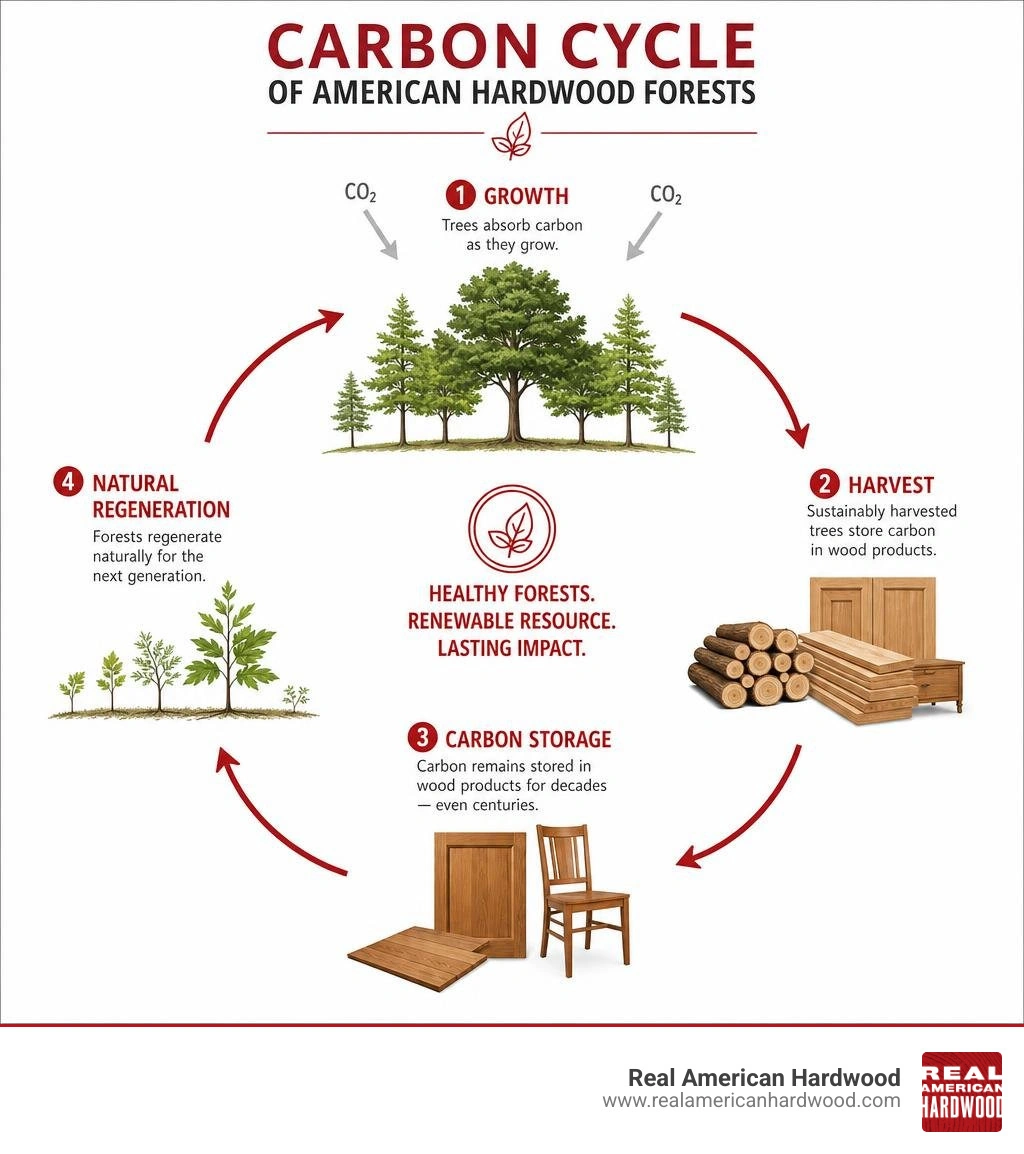
Trees sequester carbon dioxide from the atmosphere during growth. That carbon remains stored in the wood throughout the life of a hardwood product. According to USDA Forest Service lifecycle assessments, a cubic foot of air-dried hardwood contains roughly 26 pounds of stored carbon.
When hardwood is used in long-lived applications such as flooring and furniture, that carbon storage extends across decades or generations. This is a measurable climate benefit that no synthetic alternative replicates. To explore these concepts further, read about the Renewable Lumber Carbon Benefits and discover how we are creating Climate Smart Hardwood Products.
Frequently Asked Questions
Is hardwood flooring environmentally friendly?
Yes, when sourced from certified U.S. forests. Domestic hardwood is renewable, stores carbon, and is regulated under U.S. harvesting law. USDA FIA data confirms American hardwood forests are growing faster than they are being harvested.
Does cutting trees for hardwood harm forests?
Responsible selective harvesting does not harm forest health. Selective cutting, the standard practice in U.S. hardwood forestry, maintains forest structure and accelerates natural regeneration by reducing canopy competition. This is documented in USDA and AHEC forest management research.
What certifications prove sustainable hardwood?
FSC (Forest Stewardship Council) and SFI (Sustainable Forestry Initiative) are the primary independent certifications. Both require third-party audits and chain-of-custody tracking from forest to finished product.
How long does it take a hardwood forest to regenerate?
Natural regeneration begins immediately after selective harvest in most temperate hardwood forest types. Commercially harvestable timber size is typically reached within 60 to 100 years depending on species. Oak, maple, and cherry regenerate naturally through seeding and stump sprouting.
Conclusion: Does Sustainability Factor Into Your Projects?
We want to understand how architects, designers, and homeowners are weighing FSC certification, carbon storage, and lifecycle data in their material selections. Share what matters most to you and your clients.
By choosing products supported by the Real American Hardwood Coalition, you are investing in sustainable building practices, unparalleled long-term value, and the timeless beauty of biophilic design. Ready to find the perfect wood for your next project? Explore our comprehensive Hardwood Species Guide to compare options and start planning your dream home today.