

Best Hardwood Flooring: A Practical Guide
Why Hardwood Flooring Belongs in Every Thoughtful Home
Hardwood flooring has been a trusted choice for centuries — and for good reason. It is durable, beautiful, and one of the few building materials that actually improves with age.
Quick answers about hardwood flooring:
- What it is: Real wood planks, either solid (3/4 inch thick) or engineered, milled from species like oak, maple, hickory, and walnut
- How long it lasts: 50–100 years with proper care; solid hardwood can be refinished 5–8 times
- Average cost: $4–$15 per square foot for materials, plus $3–$8 per square foot for installation
- Best rooms: Living rooms, bedrooms, hallways, dining rooms, and offices
- Avoid in: Bathrooms, below-grade basements, and high-moisture areas
- Sustainability: U.S. hardwood forests grow 2.5 times faster than they are harvested
But hardwood flooring is more than a practical surface. It connects your home to something natural, lasting, and genuinely good for the planet. American hardwoods capture carbon, support over 1.8 million jobs, and come from forests that are growing — not shrinking.
This guide covers everything you need to choose, install, and care for real hardwood floors — with a focus on health, sustainability, and long-term value.
Glossary for hardwood flooring:
- durable maple wood stairs
- durable sustainable wood flooring
- durable wood flooring
Health and Wellness Benefits of Hardwood Flooring

When selecting materials for a home, architects, designers, and homeowners often focus on visual appeal. However, the surfaces underfoot play a profound role in the health and wellness of the occupants. The indoor air quality (IAQ) of modern residential spaces is a growing public health concern, and hardwood flooring stands out as an exceptional solution for creating a clean, non-toxic living environment.
Unlike synthetic flooring options, real wood does not harbor hidden hazards. To understand how real wood supports a healthier home, consider this summary of its primary physical characteristics:
- No fiber or allergen trapping: Smooth wood surfaces do not capture or hold microscopic debris.
- No VOC off-gassing: When finished with proper, compliant coatings, real wood does not release harmful chemical fumes.
- Ease of cleaning: Dust, pet dander, and spills are easily seen and completely removed with simple sweeping or dry mopping.
- Lower microbial retention: Studies show that natural wood surfaces exhibit lower bacterial survival rates compared to synthetic surfaces.
Indoor air quality is directly impacted by the choice of flooring. Synthetic carpets acts as a massive sink for allergens, trapping dust mites, pollen, pet dander, and mold spores deep within their fibers. Walking across a carpeted room continuously kicks these particulates back into the breathing zone.
Numerous European IAQ studies and GREENGUARD certification standards highlight the benefits of hard-surface flooring in reducing respiratory issues. For families managing asthma or severe allergies, replacing carpet with real American wood flooring eliminates the primary breeding ground for dust mites.
Furthermore, Volatile Organic Compounds (VOCs) are a critical consideration for indoor wellness. Many synthetic floor coverings, such as vinyl and laminate, can off-gas chemical solvents used during their manufacturing processes. Real American hardwood products finished with modern, water-based, or natural oil finishes are fully compliant with strict CARB Phase 2 standards. This ensures that your household is not breathing in formaldehyde or other chemical emissions.
Beyond physical health, natural wood flooring provides significant mental health benefits. Biophilic design—the practice of incorporating natural materials and views of nature into built environments—has been shown to lower physiological stress.
Walking on real wood surfaces or simply viewing the organic grain patterns of American species can reduce cortisol levels, lower blood pressure, and boost cognitive performance by up to 26.4% according to European biophilic design research. To discover more about how real wood flooring transforms your living environment into a sanctuary of wellness, you can read more about hardwood health benefits.
Material Science: Species, NHLA Grades, and Structural Innovations

To make an informed decision when buying hardwood flooring, it helps to understand the material science behind the lumber. The National Hardwood Lumber Association (NHLA) establishes the grading standards for North American hardwood. These grades help determine the appearance and character of the wood planks:
- FAS (First and Seconds): This premium grade provides long, clear cuts of wood with minimal natural characteristics. It is highly prized for sleek, modern architectural designs.
- Common Grades (No. 1 and No. 2 Common): Often referred to as "character grade," these planks feature natural color variations, tight knots, and wormholes. They are perfect for rustic, traditional, or transitional home styles.
The physical durability of a wood species is measured using the Janka Hardness Scale, which quantifies the force required to embed a 0.444-inch steel ball halfway into a piece of wood. Domestic species offer an excellent spectrum of strength and beauty:
- Hickory: One of the hardest domestic woods, boasting a Janka rating of approximately 1820. It is incredibly resilient and ideal for active households with pets and heavy foot traffic.
- Hard Maple: Rating around 1450, hard maple features a dense, fine grain and uniform light color, making it a favorite for contemporary spaces.
- White Oak: With a Janka rating of 1350, White Oak is highly stable and features closed cellular structures (tyloses) that make it naturally resistant to decay and moisture.
- Red Oak: Rated at 1200, Red Oak is the industry benchmark for domestic durability, celebrated for its warm tones and prominent, forgiving grain patterns.
For those interested in exploring the structural strength of these materials, our guide on Durable Wood Flooring details how different species perform under long-term wear.
Beyond traditional lumber, the American forestry industry continues to pioneer impressive wood innovations. Thermally modified hardwood uses heat and steam to alter the wood's cellular structure, rendering it highly stable, darker in color, and exceptionally resistant to moisture, rot, and insects. This process allows domestic hardwoods to perform beautifully in challenging environments.
Additionally, wood byproducts are utilized to create biochar—a soil amendment that locks carbon into the earth—and advanced biofuels, ensuring that absolutely zero waste is generated during the milling of Hardwood Timber Flooring.
Real American hardwood is not limited to flooring; its durability and warmth make it the premier choice for architectural details throughout the home. From intricate molding and crown trim to structural elements like cypress siding and even heavy-duty hickory-handled tools, the versatility of real wood is unmatched by man-made alternatives.
Solid vs. Engineered Hardwood Flooring for Interiors
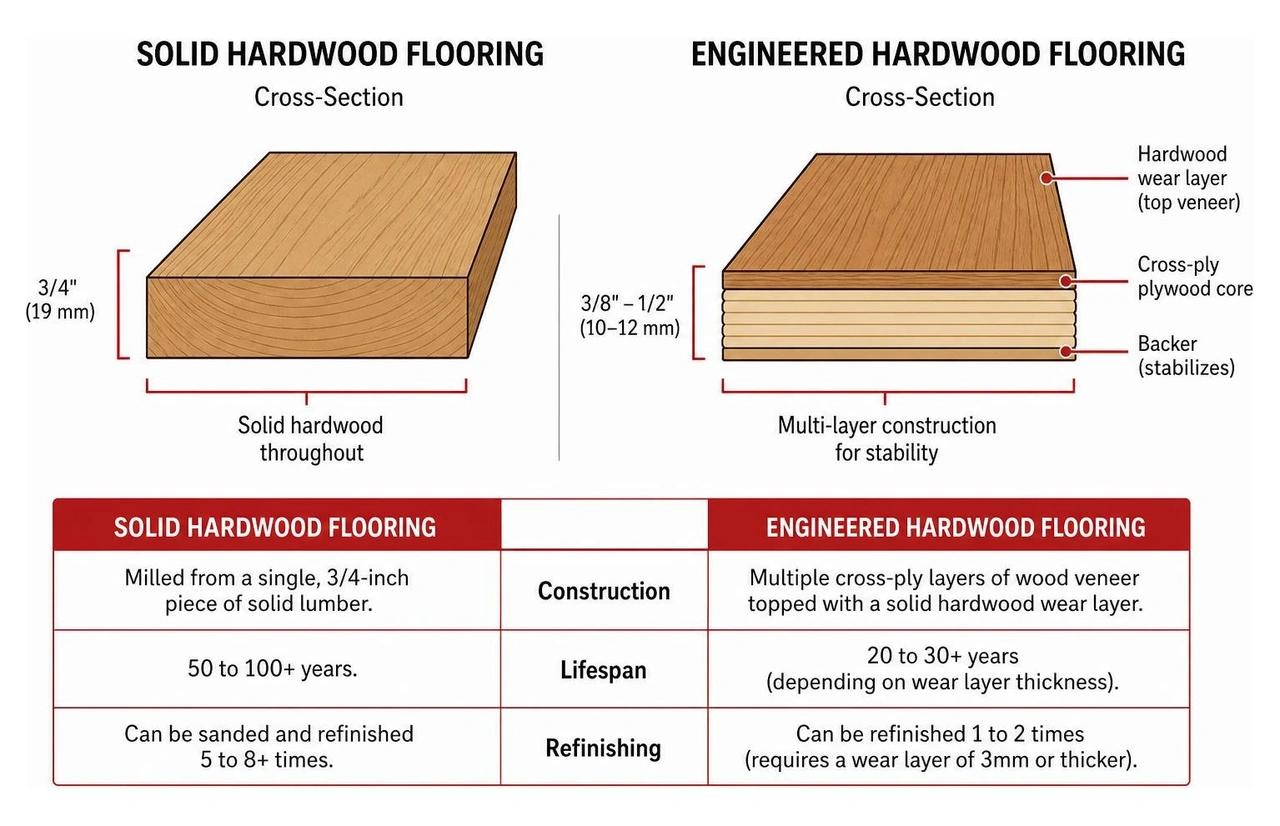
When browsing retail options like Hardwood Flooring , you will encounter two primary structural profiles: solid and engineered. Both are real wood, but they are constructed differently to serve specific interior needs.
| Feature | Solid Hardwood Flooring | Engineered Hardwood Flooring |
|---|---|---|
| Construction | Milled from a single, 3/4-inch piece of solid lumber. | Multiple cross-ply layers of wood veneer topped with a solid hardwood wear layer. |
| Lifespan | 50 to 100+ years. | 20 to 30+ years (depending on wear layer thickness). |
| Refinishing | Can be sanded and refinished 5 to 8+ times. | Can be refinished 1 to 2 times (requires a wear layer of 3mm or thicker). |
| Dimensional Stability | Expands and contracts with changes in indoor humidity. | Highly stable; cross-ply construction resists warping and gapping. |
| Best Applications | Above-grade living areas, bedrooms, and hallways. | Kitchens, concrete slabs, and areas with minor humidity fluctuations. |
Solid hardwood flooring represents the traditional standard of wood craftsmanship. Because each plank is a single, continuous piece of wood, it can be sanded down and refinished multiple times over its long life. This makes solid wood an generational investment.
Engineered hardwood, such as the premium Torrey French Oak 9/16 in. T x 7.5 in. W Tongue & Groove Wire Brushed Engineered Hardwood Flooring (1259.3 sq. ft./plt) , offers superior dimensional stability. The alternating direction of its plywood core layers minimizes the natural expansion and contraction that occurs when wood is exposed to moisture. This makes engineered options particularly suitable for challenging spaces, which you can read about in our resource on Engineered Hardwood Flooring for Kitchen.
It is also important to distinguish these high-quality hardwood options from softwoods. Hardwoods come from slow-growing deciduous trees (like oak and maple) and are structurally dense, making them perfect for high-wear interior surfaces. Softwoods (such as pine and fir) come from coniferous trees and are primarily used for structural framing behind walls, rather than high-traffic finished floors.
Selecting the Right Hardwood Flooring for Your Space

Selecting the perfect floor involves balancing upfront material costs, long-term value, and the unique environmental conditions of your home. While the initial cost of hardwood flooring materials ranges from $4 to $15 per square foot (with professional installation adding $3 to $8 per square foot), real wood consistently returns up to 2.5 times its cost upon property resale. It is an investment that pays dividends by elevating your home's market appeal.
Before purchasing your materials from trusted suppliers—whether you choose to Buy Solid Hardwood Flooring or browse curated options for Discount Hardwood Flooring —it is vital to prepare your space.
Real wood is a living material that reacts to its environment. Planks must acclimate to the temperature and humidity of the installation room for at least 3 to 5 days before being laid down. Storing the planks flat in the designated space prevents warping and ensures a seamless fit.
Additionally, the subfloor must be dry, flat, and structurally sound. Solid wood floors are typically nailed or stapled down to a wood subfloor, whereas engineered floors can sometimes be glued down or floated over cured concrete slabs.
While looking at options, some homeowners consider alternative materials. However, when comparing real wood to synthetic alternatives, the difference in quality and longevity is clear. To understand how real wood outperforms vinyl and laminate in both aesthetics and long-term value, read our detailed comparison on Hardwood vs Lookalikes.
If you are looking for design inspiration, you can also explore our guide on the Best Laminate Flooring That Looks Like Hardwood to see why natural wood remains the gold standard. For professional success, be sure to review our essential Hardwood Flooring Installation Tips before starting your project.
Environmental Stewardship and Sustainable Forestry

One of the most compelling reasons to choose American hardwood flooring is its extraordinary environmental profile. Unlike synthetic materials derived from petrochemicals, real wood is a truly renewable resource.
The sustainability of North American hardwood relies on natural regeneration. Rather than relying solely on hand-planted monoculture plantations, American hardwood forests regenerate naturally through seed dispersal and stump sprouting. This preserves complex, biodiverse ecosystems that support local wildlife, maintain clean water tables, and protect soil health.
According to forest inventory data compiled by the United States Department of Agriculture (USDA), the American Hardwood Export Council (AHEC), and the NHLA, North American hardwood forests are growing 2.5 times faster than they are harvested. This means that for every tree harvested, more than two new trees grow in its place.
In specific regions, such as the Appalachian mountains, the timber resource is verified to be growing at 2.4 times the rate of harvest and natural mortality combined. This makes Appalachian Hardwood a premier choice for eco-conscious builders.
From a climate perspective, real wood acts as an incredibly efficient "carbon bank." Through photosynthesis, growing trees absorb carbon dioxide from the atmosphere and lock it away as carbon. When a tree is harvested and milled into flooring, that carbon remains safely stored inside the wood for the lifetime of the floor—which can easily be a century or more.
Milled hardwood flooring emits only 9.2 kg of CO2 equivalent per square meter over its lifecycle, compared to a massive 41.8 kg of CO2 equivalent per square meter emitted by synthetic vinyl flooring.
To ensure your wood comes from responsibly managed lands, look for certifications such as the Forest Stewardship Council (FSC) or the Sustainable Forestry Initiative (SFI). By choosing locally sourced, certified American hardwood, you support rural economies, reduce transport emissions, and champion responsible forestry. You can read our Ultimate Guide Sustainable Wood Flooring to learn more about making an environmentally sound purchase.
Frequently Asked Questions
How does real wood flooring improve indoor air quality?
Unlike carpeting, which traps dust mites, pet dander, and microscopic pollen deep within its fibers, real wood flooring features a smooth, hard surface that does not hold onto allergens. Spills, dust, and dirt are easily wiped away, reducing the microbial load in your home.
Furthermore, real American hardwood products do not off-gas harmful VOCs when finished with compliant, water-based coatings, helping your household meet strict CARB Phase 2 and GREENGUARD indoor air quality standards.
Can engineered wood planks be refinished as many times as solid wood?
No. Solid hardwood planks are typically 3/4 inch thick, allowing them to be sanded down and completely refinished 5 to 8 times over their 100-year lifespan.
Engineered wood planks feature a real hardwood wear layer over a plywood core. Depending on the thickness of this top wear layer (ideally 3mm to 6mm), engineered planks can generally only be sanded and refinished 1 to 2 times before the core layer is exposed.
Why is American hardwood considered a carbon-negative building material?
Trees naturally absorb carbon dioxide from the atmosphere through photosynthesis, locking the carbon within their wood fibers. When wood is harvested and manufactured into durable interior products like flooring, that carbon remains sequestered for decades.
Because North American hardwood forests grow at a rate of 2.5 times faster than they are harvested, the entire forestry system acts as a net-positive carbon sink, storing far more carbon than is emitted during manufacturing and transport.
Conclusion
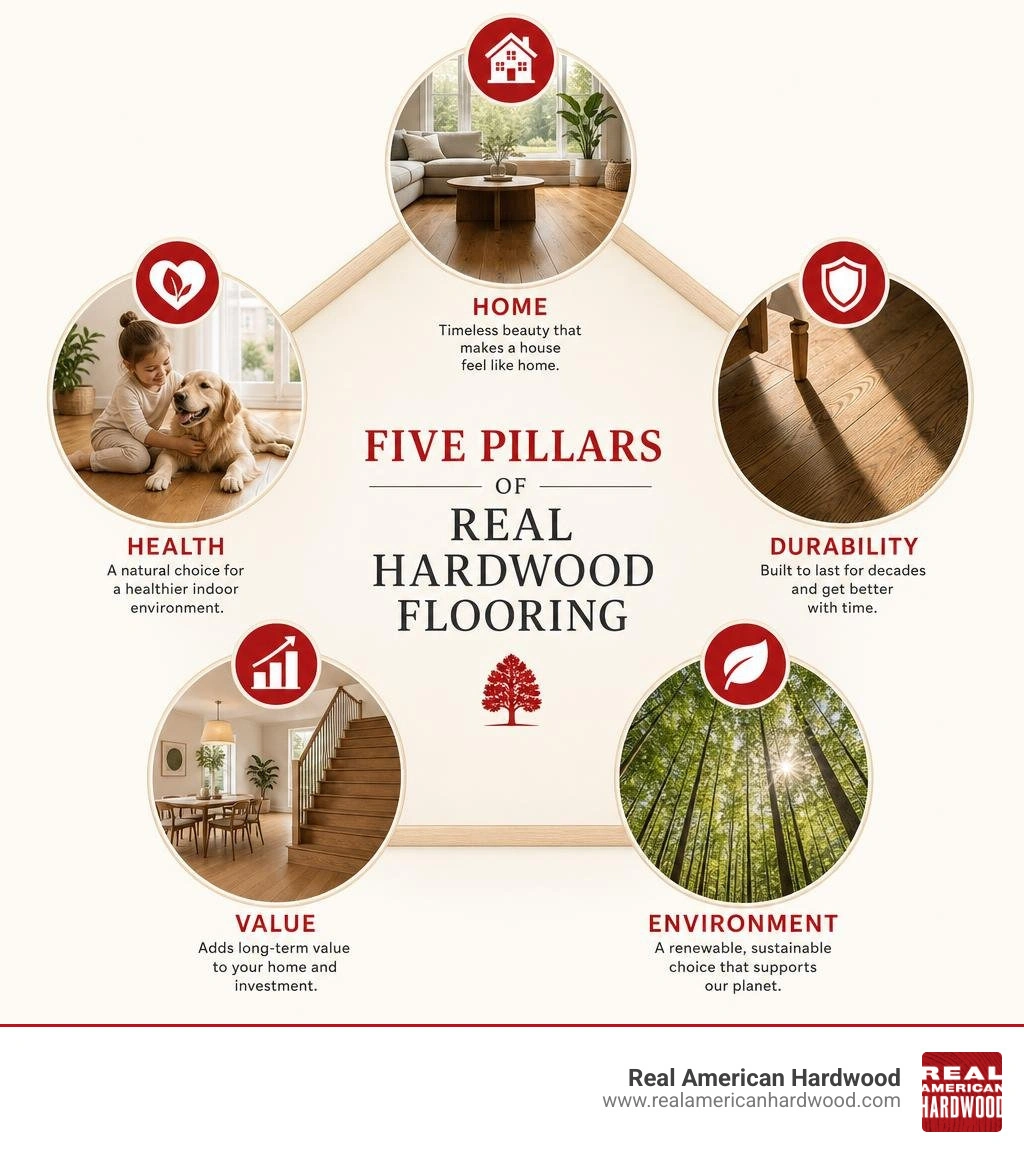
Choosing the best hardwood flooring for your home is an investment in a beautiful, healthy, and sustainable future. Real American hardwood excels across all five core design pillars:
- Home: It brings unmatched warmth, character, and biophilic beauty to every room.
- Health: It actively improves indoor air quality by eliminating allergen-trapping fibers and harmful chemical emissions.
- Durability: With Janka-tested strength and the ability to be refinished multiple times, it easily lasts for generations.
- Value: It consistently increases home resale value and outlasts multiple installations of synthetic flooring.
- Environment: It is a naturally regenerating, carbon-negative resource sourced from thriving, expanding American forests.
By choosing real wood over synthetic lookalikes, you are not just designing a beautiful home—you are supporting sustainable forestry and building a healthier indoor environment for your family.
To explore the endless design possibilities of real wood and find the perfect match for your next project, visit Build Your World with Real American Hardwood.